Search This Blog

Showing posts with label church. Show all posts

Thursday, December 31, 2015

Jesus is NOT all I need


One year has ended and another has begun. For many people, a new year signifies new life, new hope, new dreams and goals. For others it is a reminder of things now gone, loves lost, and the struggle that is awaiting them.

For me this new year feels different from others. My birthday is new years eve and usually this means that there is fun, presents, and all the good stuff of birthday's, as well as the joy of being on holiday and also getting to celebrate the turn of the year with everyone on the same day. It is usually a great time.

This year, not so much. Not because anything really changed around me - I still got presents and all that - but because I feel different about it. Maybe it was because I was working for the first time ever on my birthday and now also on New Years Day. Maybe that made it feel just like another day rather than anything special like years past.

Or maybe it was because I am now in my 30's. Last year I turned 30, which is always a big celebration, but this year I am 31. No big celebration around that, I have just officially become a 30-something year old. This has triggered a small emotional crisis for me for several reasons:

1. I am in my 30's but my husband is still under 25. Now we have different numbers at the start of our ages it seems like such a bigger age gap than before. I feel like telling people our ages now will get even more of a reaction than it has before.

2. I still feel 24! Maybe it is because I am at the same level as my hubby, but I feel his age rather than mine. The fact that I also became sober around 23/24 after drinking since 15 means that I have developed slower emotionally than others my age - this is a proven thing that happens to addicts - and the fact that for many years I was mentally unwell means that I feel those years are missing and in my memories I am much younger than I feel. Or maybe everyone feels this way when they get older...who knows!

3. For some reason leading up to 30 feels like you are still growing up. Birthdays are still exciting and  you are still considered young. Now it feels like birthdays are less about growing up and more about getting older. Maybe popular culture has sold me the idea that it is all down hill after 30, because now it feels like it is all downhill from here.

4. I don't feel like I have accomplished as much as others my age. I have a friend who I have known for pretty much all my life. She is a trained lawyer, has a house, several investment properties, a husband, 2 kids, and a dog. I have a husband......and that is it. I am not in the job I trained for, have no kids, don't own a house, etc. Though I know I shouldn't compare my life to others - as I have gone through things that she hasn't and vice versa - it makes me feel like I should've done more.

Perhaps these are common things for people to feel as they get older, and I certainly hope I am not the only one who feels this way! Or maybe the year Luke and I have had has put me in a melancholic mood. 

We have had a tough year emotionally, spiritually, mentally and physically. We have moved cities, jobs, houses, churches. We have been in traffic accidents, faced the mortality of loved ones, struggled with our own health issues, and tried to understand God in the midst of suffering. It has been the toughest year we have faced as a couple, and we are both glad that it is over and a New Year has begun.

In the midst of all of what we have been going through, one thought has been playing around in my mind. It was spawned by listening to a Christian radio station and hearing so many songs about how Jesus is all I need. The songs basically all say, no matter what, no matter how crappy life is, Jesus is really all we need, ever.

Though these sentiments are probably helpful for many people, I find them somewhat difficult. Jesus is the Way, the Truth and the Life but not even he said that he is the only thing we ever need. He said we cannot live on bread alone, but need the Word of God, and that he is the Water of Life and those who drink from him will never be thirsty, but did he mean that he was all we need for every situation?

I would argue that no, he is not. Because Jesus himself commanded us to love God with all our heart, mind and strength, and to love others as we love ourselves. Jesus can't be all we need because we are made to be in relationship with others. You can have a great relationship with Jesus and he can be your solace in times of pain, but without other people you are still lonely. You are not being fully human to only rely on Jesus for all your emotional needs.

God created us to be together. Even when he created Adam, who was in perfect relationship with God and walked and talked with God, God saw that humans should not be alone. It is only in relationship with others and with God that we are complete. Yes, these relationships are distorted in a fallen creation, and yes, these relationships can draw us away from God if we let them, but they can also bring us closer to God through our love for others and their love for us.

If we begin to face hard times with the belief that Jesus is all we need, then we do ourselves and others a disservice. We do not allow others to minister to us, to show Jesus to us in our hurt, and we also do not allow others to see God at work in our weakness. By blocking out others as something we need, then we block out an aspect of God at work in our lives also. Faith then becomes about the individual and not about the church; about how I feel about God, and not about the witness of others; about my personal relationship with Jesus at the expense of vulnerability and humility in our communities.

I have had a tough year, and I am going through an emotional crisis, but it is my relationship with others and with God that helps me get through these things. It is in my dark moments, when I am incapable of feeling the love of Christ because of my pain, that it is the love of others that ministers to me. It is through their words, their actions, and their care of me that I see and hear God. It is also when they tell me off or tell me I am not listening to God properly because of my pain that I realise that God himself is speaking to me. As iron sharpens iron, so the members of the church sharpen each other. 

So next time you are thinking God is all you need, look at what God says about that. Love one another as Christ loved the church. Lay down your life for each other, carry each others burdens, feel each others pain, and minister to the weak, wounded and hurting around you, and let others do the same for you. We are the bride of Christ and need each other just as much as we need our Saviour.

Jesus and the church are what I need.

Sunday, November 8, 2015

Trudging when you want to Fly


I have this amazing friend who I love a lot. She and I are very similar in some ways and in others are completely the opposite. We use to live next door to each other and would see each other all the time for coffee and catch ups, but now we are in different cities and I miss seeing her and being able to chew the fat.

She is an incredibly talented and passionate woman, but she suffers from a debilitating illness. It is one of those illnesses that doesn't show on the outside so often people don't realise that is just a struggle for her to get out of bed some days. If she does make it out of bed, that is an epic win! But she doesn't feel like that. She feels like she is trudging when all she wants to do is fly.

Her and I were talking about it about it last night, and I really feel like I know where she is coming from. I too feel like I am just doing the daily trudge at the moment. Though I do not have an illness as severe as hers, I do get migraines that throw out my plans. I have to watch how much I do, how often I rest, and when I take my medication. I feel like my life is dictated by me head.

I also know how she is feeling when she asks me what God has planned for her and how it is possible. I sometimes feel like I have done all this study and research and now I am not using it or working in the field I am most passionate. I feel like I just live from day to day waiting for the opportunity to do something else, something more.

Our experience of church is very much dictated by our experiences of life; we both find it a struggle to go to church. We find it hard to do small talk with people who don't really know how we are struggling silently. We find the music often contrite and dishonest to how we are feeling. We can find the sermons boring and/or rip them apart mentally due to our theological training. So we tend to avoid church, or go very unwillingly.

We are trudging, but oh how we want to fly.

During these times it is the story of Joseph that really sustains me. If you know the story, fell free to let your mind wander as I summarize it for those who do not.

Joseph was the second youngest of 12 brothers. Though usually the eldest brother was the most loved, the most favoured, but Joseph, the first child of two children from the favourite wife of Jacob, was the most loved by his father. We was doted on and, frankly, was a little spoiled and outspoken to boot. He annoyed his brothers by telling the of dreams he had where his whole family would bow down to him. In a fit of rage, the brothers took Joseph, intending to kill him. Instead, they sold him to slavers that then took the young boy to Egypt to sell. He was sold to Potiphar, an important man, and he worked hard to please his master. However, his master's wife took a little too much of a liking to him and, when he didn't reciprocate, falsely accused Joseph of rape. Joseph languished in prison for 14 years, working hard and earning the respect of the guards of the prison in the process. When fate brought two men of Pharaoh's household to the prison, Joseph was given the opportunity to interpret their dreams and, in the process, asked them to remember him to Pharaoh. The dreams came to pass as he said, with one man being killed and the other being reinstated in his former position. It was another two years before Pharaoh had a dream and the reinstated man remembered his promise to Joseph. He told Pharaoh about the now fully grown man, and Joseph was released to interpret the Pharaoh's dream. He did so correctly, thorugh the Spirit of God, and was made second only to Pharaoh in all of Egypt. Eventually a famine struck the land for 7 years and Joseph's brothers were needing food. They went to Egypt to ask for grain from Joseph, who had been preparing for the famine for years after being warned in Paroah's dream. It was then that the dreams of seeing his family bow before him were fulfilled. Joseph forgave his brothers and brought his whole family to Egypt and died an important, wealthy and loved man.

That was a very brief explanation of the story. If you want more look it up in Genesis and have a read. It is worth it.

Anyway, back to my point.

It was 16 years before Joseph was set free. He didn't know if he would ever get out of prison alive. He didn't know what the plan was or how God would get him out of it all. He had a terrible experience as a child and now he was locked away for something he didn't do.

If I was Joseph I would have despaired. There seemed to be no hope, no light at the end of the tunnel, no justice.

Even though the story doesn't end that way, it is this part I want to focus on. The part where for 16 years Joseph trudged through everyday in prison.

He had dreamed he could fly, and was made to trudge with no end insight.

But it was he did in prison that impresses me so much. He worked so hard and so faithfully that the head of the prison made him his right hand man. He was put in charge of other prisoners and earned the respect of both them and the people paid to keep him locked up. He didn't give up, he just found another way to serve God.

This challenges me. So often I ask God what his plan is for my life and when will it come to fruition. But really, all God calls us to is to live faithfully in loving him and loving others where ever we find ourselves


Whether we are trudging or flying, our purpose is the same. Whether we feel defeated or elated, our response to God and to others is meant to be the same. We are meant to live faithfully in love. Maybe our circumstances will change, maybe they won't, but that should not determine how we live or what God is asking from us.

We may feel like we are trudging, but it is living out our faith in Jesus that brings us to flight, whether we feel it or not.

Remember that it is the sacrifice and love of God that makes us fly, not what we do or where we are headed. We may feel like we are in a prison and that we will be in it for life, but it is how we live and how we respond to God that will define us.

I look back at the last ten years of my life and see how far I have come, even though most of it has felt like one long trudging slog. I remember that this time a decade ago I was in an abusive marriage, was alcohol dependent, was in and out of psych wards and suicidal. Today, I am loved, happy, healed, and 7 years sober. It was a long hard walk, but I am flying, whether I feel it today or not. God's work in our lives is not dependent on our feeling it. However, it is our hope in God that keeps us going everyday.

You may continue to trudge, but remember that it is our hope that makes us fly.


Tuesday, October 28, 2014

Which is more important....forgiveness or healing?

On my way to work in the mornings I tend to arrive at the train station about 10mins early so I can sit in my car and read my bible and pray a bit (I know, I am so holy and I put you all to shame). I do this so I start my day the right way, focused on God and not on how tired, grumpy, wanting to be in bed I feel.

Sometimes I just go through the motions. I don't really take in what I am reading and/or I don't really care (maybe not that holy after all). But sometimes what I have read really gets me thinking.

Like yesterday for example.

I was reading Mark 2:1-13. For those who don't know their bibles off by heart (shame on you.....you are going stright to hell, do not pass go, do not collect $200...jokes) this bit tells the story of a paralytic man. Jesus is chilling in a house, maybe eating some dinner or something, when the people of the town hear he is there. Like the celebrating swarming of the 1st Century, they all flock to see him, filling the house and the road outside and basically acting like people do around the Kardashians today, but for much better reasons (hopefully). 


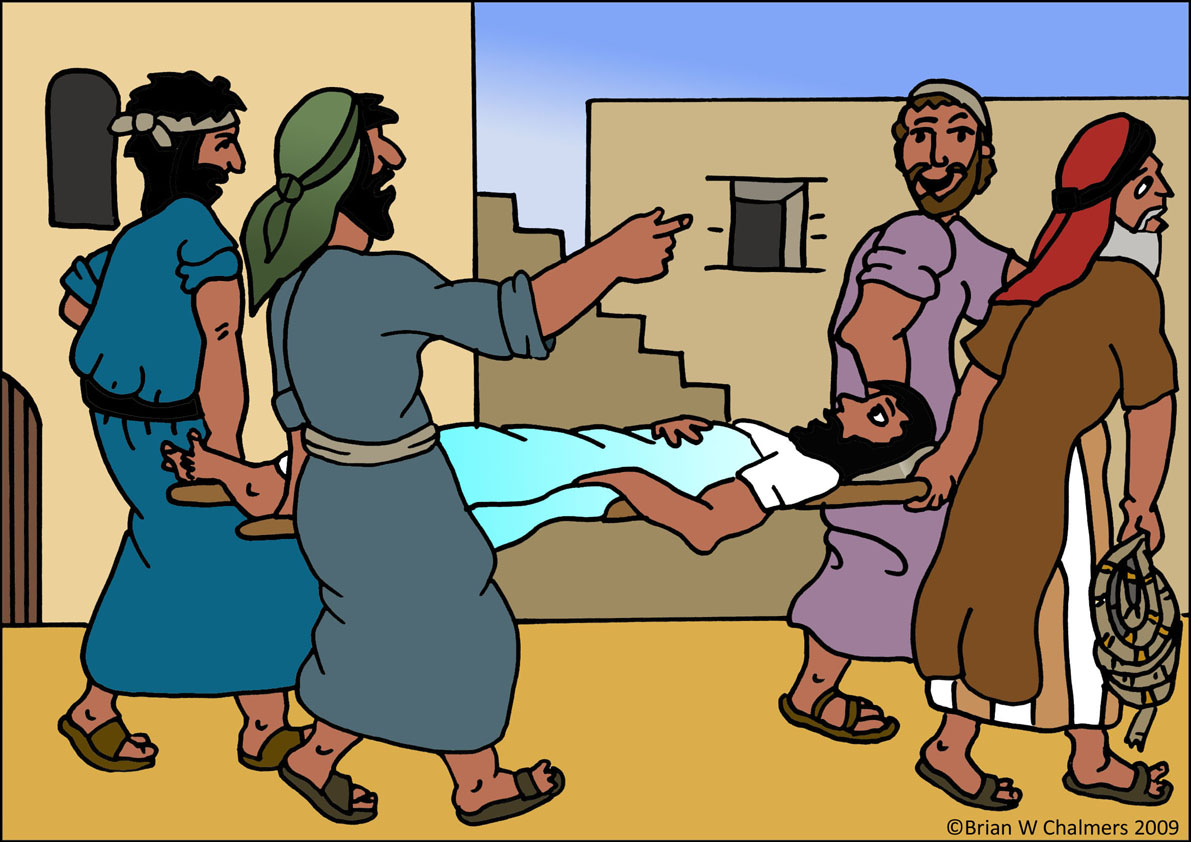
In this town there is a paralytic man who is hanging out with his mates, who start to think to themselves that maybe they should get him to see Jesus and maybe something like a healing would happen (because by now stories of Jesus' healings have spread). So they pick up this guy on his mattress and start carrying to the place where Jesus is.

When they get there the doorway is full of people who are not gonna give up their precious opportunity to see and hear Jesus. Perplexed, these fellas start brainstorming and decide to climb up on the roof (which is flat in this part of the world, and usually has stairway access), and dig a hole through the roof (really hope the owner was pissed off that this) and then lowered the man, mattress and all, down to right smack bag in front of the great man himself.


Now I can imagine Jesus looking at the man on the mat, then looking up at the hole in the ceiling and breaking into a huge smile. He is really impressed with the faith and commitment they have all shown. So he looks at the man and says "your sins are forgiven." Some religious elders and stuff and kinda annoyed by this because in their reckoning only God has the authority to forgive sins and Jesus is a man. So Jesus (apparently reading their minds!!!) looks at them and says "which is easier, to forgive sins or to tell this man to get up, pick up his mat and walk. But so you know that the Son of Man [a title Jesus uses for himself] has the authority to forgive sins..." he looks at the paralytic man "stand up, pick up your mat and walk home." And the dude, who is paralysed remember, gets up, picks up his mat and walks out.

Now there are many amazing things about this story. I mean, the paralysed guy would have had muscles that were all shrunken and munted and yet he could get up and walk straight away! The full body healing that occurred here is mind blowing in medical terms. It is not just the cause of his paralysis that is healed, but all of the issues associated with that. All instantaneously!! Flippin wow!


But what struck me yesterday was not the healing. It was that the healing was almost an afterthought in the story. 

Jesus didn't heal the guy immediately. He forgave him first. And then he implies that it is harder to forgive sins than to heal this man.

The healing is not of the first importance to him!!

This made me think about the priorities I would have placed on this story. If I had been Jesus I would have healed the guy first then said something like "BOOM! Look at what I can do! Now believe all you peeps, because I am badass and,as a bonus, I will forgive his sins too!"

In churches I see the same thing. We pray often for people's healing, but how often is there salvation or relationship to God seen as more important than their physical ills. It is the mentality that says "show me a miracle first and then I will believe and ask to be saved."

And yet that is directly opposite to what Jesus does here. His main focus is on the spiritual ill of the man. He sees that the healing that had to occur between this man and God was more deadly, more disastrous than the physical disabilities he had. This reconciliation of man and God was the priority.


How would this attitude impact how we speak to people with disabilities and illnesses? If we adopted this attitude what would change in our hearts towards others? Would we stop seeing people with disabilities as something to be pitied but rather view the state of their faith as more important? Would their disability pale in comparison to their knowledge of God? Would we approach them differently? Would we approach our own issues differently?

I for one am someone who empathizes greatly with people who suffer from disabilities; I have been one and, but for the grace of God, would still be one. I remember feeling like if people prayed for my healing and it didn't happen, that I or they had failed in their faith. I stopped asking for prayer because I felt ashamed.

It was in the prayers of some ladies who prayed for God to be made known to me, not to be healed, that I was healed. They prayed for my salvation, and God, like in this story, forgave me first and healed me second. And the first was more important for me than the second. My shame and fear was lifted. Even if I had remained in my illness I believe that my experience with God in that moment would have changed my life anyway, even if not others perception of my life.

So when you pray for healing for others (and I am not saying not to) remember that of greater importance to God is that this suffering person would know the love and forgiveness of Christ. It is then that true, deep healing is found, that the broken is made whole, and the world is reconciled to its Creator.


Tuesday, July 15, 2014

Loving My LGBT Neighbour?

I, like everyone else not living under a rock, is aware of the fact that the world is changing in regards to homosexuality. Laws are changing in many countries to allow homosexual couples to marry, decriminalising homosexual lifestyles and basically allowing homosexuals the same rights as their straight counterparts.

However, this isn't the case in other countries. Uganda is one such example. Watch the below video to catch up a little as to what is going on.


This clip is satirical in nature so maybe something a little more serious is in order.

It cannot be denied that to be homosexual in Uganda is somewhat dangerous these days and that this atmosphere of intolerance has been fuelled by extreme views by pastors claiming to be of the Christian persuasion.

So what? I hear you ask. Why do we care? Uganda is all the way over there and we are here and it doesn't affect us. Why don't the homosexuals just go to another country and leave Ugandan's to their ideas?

Well, let me just throw a few things out there for you.

1) This issue has been inflamed by the West stirring things up in Africa. This makes it our problem because it began as our problem.

2) Anything that hurts human rights for any human being should be our business. We are human. We don't like being treated like less human than other people. Therefore we should be really concerned if some people are being treated that way. Just as we now get upset if anyone claims that a black person is less human than a white person (which use to be law just fyi), we should be upset if someone says that a gay person does not deserve the same rights as a straight person. Saying that basically relegates the gay person as less human as the straight person. If you wouldn't like to be treated that way then you should be flipping upset if it is happening to someone else.

3) Why should people be kicked out of their country because they choose to live in a different way with a consenting adult? I am not talking about a crime that is dangerous and hurtful. Homosexuals are not paedophiles or dangerous to anyone. They just want to be treated as a human being who gets to choose their lifestyle. Why should they have to leave for that?

Now I need to state something before I go any further. I am a Christian and I do not agree with the homosexual lifestyle. I don't believe that being Christian and not agreeing with homosexuality goes hand in hand for many people, but for me they are linked. HOWEVER, my gay friends (yes, I do have them) know this and we are able to talk about our opposing views with love and respect. 

My views on homosexuality HAVE NOTHING TO DO WITH my views on human rights.

And this is an issue of human rights NOT religion, faith, belief, sexuality or anything like that.

As a Christian, above and beyond everything else, I love God and I love others. 

To love others is to always, no matter the issue, stand with those who are being oppressed. It doesn't matter if they are being oppressed for being a woman, being black, being Muslim, being gay, or being a vegetarian. If someone is being oppressed, if their dignity and worth as a human being is being taken away and/or abused, then it is my duty as a Christian to stand with them, to speak for them, and to fight for them.

What is happening in Uganda to the LBGT community is WRONG. 

It is wrong that people are living in fear because of sexual orientation.

It is wrong that when I watch the above video I am ashamed of the Christians and being associated with them (on another note it is not wrong that I totally proud how Pepe dealt with that awful interview).

It is wrong that when I post pro gay statements on Facebook that I get slammed by Christians who see it as bad that I can support people fighting to be heard as equal human beings.

When Christians speak only about why we stand against homosexuality all we do is paint Christians with the homophobic brush. Everyone is well aware of how we feel about homosexuality by now. I don't think anyone is surprised when a Christian says that they don't agree with that lifestyle. Duh!

But to stand with the LBGT community as they fight for equal rights is something unheard of. It is something that has the potential to bring reconciliation and love between to opposing camps. It has the possibility of showing the love of Christ to those who are all to aware of what we stand against.

So I guess the last reason Uganda should be on our radar is because it is symptomatic of the arguments that are occurring between Christians and LBGT communities. It shows what happens when those conversations become part of law. It shows how hate can be taken to a national scale.

Uganda, if nothing else, should make us pause and think about what our words sound like to those who are LBGT and what impact that may be having on the wider global community.

Wednesday, April 30, 2014

A Mother to Hold


Mother's day is coming up fast in New Zealand. It is a time of families celebrating the woman who brought them into the world. Churches around the country will be holding special services that have children handing out gifts to mothers and a sermon focusing on someone like Mary, the mother of Christ.

There is a lot of stuff around mothers happening around me at the moment. My new niece was born a few days ago. Many of my friends are pregnant and giving birth. My mother in law is battling cancer so my thoughts are with her a lot. Hubby and I are thinking about babies and when to start trying for them.

Mothers have such an impact on our lives, for good or bad.

And recently I have been missing my mum.

I have talked briefly about my breakdown in relationship with my parents without giving too many details. I don't think this is the place to vent my issues with them. But suffice to say that it is coming up three years since I have seen or had any contact with either my mother or father.

I love my parents deeply, we just have some issues that we can seem to sort out.

Every month or something hits me that makes me miss my mother like crazy.

This month it is mothers day.

It makes my heart hurt when I think about her. I feel empty and lost, like a part of me is missing. I wish that things could be different and we could talk about things but life is not like that. Things happen.

The thing I have been thinking about is around all of this.

Mother's day was created by a card company that wanted to make profit. The church in NZ has bought into it hook line and sinker. And though I admire the sentiment I think it is wrong.

It is wrong to have one day alone when we celebrate mothers. I think it is wrong because it puts pressure on all those people who don't have mothers, can't be mothers, or have issues with their mothers. It affectively isolates those who are already hurting by pushing in their face what they don't have.

Don't get me wrong, I am not trying to push my misery on everyone but being a grinch about mothers day. I am all for celebrating mothers. But I don't think that the church, a place that is (or should be) full of broken and hurting people, should be focusing on this topic when the rest of society already does.

I mean let's face it, if my church doesn't do mothers day, I am not exactly going to miss it am I. It is all over TV, shop windows, and magazines. I would have to live in a cave to miss the sales that are being pushed in my face to buy my mother things like diamond rings and dishwashers. 

Kids will still be able to get cards for their mums, make them breakfast in bed, and show love to the special woman in their life.

But church? Church should be at least one place where people can find solace for their pain. That on a day that might be really hard for people there is a place where they can go and not have it shoved in their face. Where grief is acknowledged as much as joy.


But the church doesn't do grief well. We don't know how to lament with others. Church songs tend to focus on how happy we are that Jesus has saved us, rather than the pain of still living in a fallen world. We emphasise one and totally ignore the other.

In the last 24 hours I have talked to three women who find mothers day hard. One cannot have children, one doesn't have children yet but really wants them, and one whose mother has passed. Each of these women go to church and each them told me how they would avoid church on mother's day. 

There is something wrong when the people who are hurting are avoiding church in order to avoid more pain.

It's time to rethink how we do this in such a way that we don't diminish the joy but don't ignore the pain either.

Wednesday, October 16, 2013

Wanting to Belong

(the second part of "why I can't be a Muslim....ever" will be posted next time but will be taking a break for this post)

This weekend just gone I had the supreme privilege of being asked to go down to New Zealand's most Southern city, Dunedin, to speak about my experience with mental illness and how the church can take part in the healing and reintegration of people with mental illness back into the community. I was there from Friday afternoon til Monday morning and managed to squeeze in six different talks to a variety of groups and churches.

Apart from being absolutely shattered I loved my time down there. It was an awesome city with an awesome vibe and beautiful architecture. Below is the main talk I gave on the Friday night to a bunch of different church people (along with pics of my time in the beautiful city). I hope you enjoy.

----------------------------------------------------------------------------------------------------------------------------------

Mary was upset. A man that she didn't like was whispering nasty things in her ear and touching her inappropriately, and she didn't like it. She told him to stop it but he wouldn't go away. So she started to yell at him, screaming at him to leave her alone. When I found her she was lashing out at the man and screaming at the top of her voice for someone to help her.

Natasha knew that she was sick. She could see it in the mirror every day. Her skin was starting to fall off her bones. She could see where it was tearing and bleeding and she didn't know how to stop it. She had been to the doctor many times about it but they kept telling her that it was ok. She knew it wasn't ok, and by the time I heard her story she was in a panic about how to fix it.

Mary and Natasha are real women who both experienced extremely traumatic events. However, both these women did not receive the help they needed to process what they went through.

For any other people these circumstances would have warranted counselling, church prayer meetings for the women, friends coming alongside to console and advice. Hey would have received medical treatment for their experiences and gained compassion and love from every quarter. Mary and Natasha didn't received any of this.

Because what Mary and Natasha experienced were hallucinations brought on by extreme mental health problems.

Tonight I have the privilege of being able to talk to you about mental health and the church. I can't do that without first telling you a little about myself. I am 28 years old, have been married for two years, am completing my Masters thesis and am looking at doing a PhD in mental health and theology.

6 years ago my life was very different. When I was 12 I developed early onset schizophrenia. By age 19 I lived with full blown psychosis, was in and out of the psychiatric ward at my local hospital, and had attempted to take my life numerous times. At age 22 my parents were taking care of me full time, I had ballooned from 75 kilos to a massive 200+, and I had been told that there was no cure, that mine was a life long sentence.


Enter the little old ladies on the church prayer team. Their prayers that day 6 years ago completely changed my life and thanks to the grace of God I am able to stand before you today free from extreme mental illness, free from medication, and able to share my story and give a voice to those who are often unheard.

My life is a life of terrible suffering and miraculous healing. 

While I was unwell for all those years I was actively involved in my church. This involvement did become less the more unwell I became, but what also became apparent was that I was more UNWELCOME the more unwell I became.

No one ever said to me “You are not welcome here.” I was never asked to leave or told I couldn't join a particular group. I was always greeted warmly at the door every Sunday, and prayed over when I received communion.

I was included. I just didn't belong.

People ceased to ask me out for lunch or dinner. I saw numbers dwindled in my home group and heard the whispers that it was because I made people uncomfortable. I wasn't asked to group outings to the movies or the pools. In fact, between Sunday and Sunday I didn't see anyone from my church. I was alone at home. I was at home, lonely.

As my mental health deteriorated so did my understanding of social niceties. I was a difficult person to be around. I never stopped talking. I would speak too loud. I would fall asleep at church and snore. I would eat anything that stopped long enough for me to grab it and put it in my mouth. I was bad at personal hygiene. I was big, loud, smelly, and an embarrassment to the people around me.

So people stopped being around me. I don't blame them, I really don't. It is really hard to spend time with someone that you can't relax around. It is hard to visit the house of someone who smells bad and won't let you leave. I exhausted people. I drained them.

Natasha exhausted people too. I met Natasha in the ward. She was a sweet woman in her 50's who had experienced a psychotic break with reality. She truly believed her facial skin was tearing off. I avoided her like the plague when I was there. If she could corner you she would tell you non-stop about her face and you would be stuck there for hours. She would follow you around too if you tried to walk away. She was embarrassing and exhausting and so I went out of my way not to talk to her.

I didn't care that Natasha was genuinely concerned about her face. I didn't care that she needed someone to talk to. To me she was a crazy old kook who I wanted to stay away from.

I still think about her and wonder what happened to her.

While in the wards I was exposed to many more people and behaviours that, in my early twenties, I was completely unprepared for. I watched a heavily pregnant woman attack staff and have a fire hose turned on her in an effort to control her. I heard the same lady describe her unborn child as a demon. In reality it was her fathers. I met a 17 year old boy who was dropped off by his parents for suicidal behaviour. He remained there for a week with no visitors. I was verbally abused by a man who thought I was his mother, and I was confronted by nurses who were in equal measure compassionate and careworn. When not in the psych ward I was a daily visitor at the day ward with other mental health patients in the community. Though this was a much more pleasant environment I was surrounded by people I did not know, that were usually much older than me, and by community workers who were understaffed and overworked. The people there embarrassed me with their weird behaviours and I felt left out and alone.

One thing that these people and I had in common was we were all identified by our labels. I was schizophrenic, which meant that nothing I said could be trusted as real. Others were bipolar, which meant you had to watch out for mood swings. Others had extreme depression so they were kept away from anything sharp.

Diagnosis of a mental illness alone creates greater issues for the patient than suffering the illness alone. Diagnosis locates the illness entirely with the individual, apart from their family and environment. It claims that there is something 'wrong' with the person that defines them as outside the acceptable 'norm'. This reduces hope of recovery, creates stigma from labelling, and turns a person into a category.

Currently in NZ today it is estimated that 1 in 4 people will suffer from a mental illness at some point in their lives. It is estimated that 38% of europeans, 62% of Maori, 59% of asians, and 59% of pacific islanders will be diagnosed with a psychotic disorder, such as schizophrenia, in their life time

I find that when I speak of my experiences with mental illness I am met with 1 of four reactions by the listeners. The first is ambivalence. These listeners cannot relate, or don't know how to, and so are quick to change the subject and to move out of the area of a topic of which they have no understanding. They may think that mental illness is “all in your head” and something that can be changed by will power, or they may simply have no interest in the matter.

The second reaction is nervousness and confusion. These listeners mean well but simply do not comprehend what mental illness is or how to respond to it. They may look at you like you are about to pull out a gun and start a rampage, or they may ask to pray for you to release you from the demonic stronghold over your life. These are the listeners that will offer to pray for you but end up lost for words as they become confused as to what to pray for. They often super-spiritualize your experience in order to bring the conversation into a language that they understand.

The third group is perhaps the most interesting of reactions. They are the group that leans forward with eyes shining lapping up every word. When you have finished speaking they will say things like “that is so cool” and ask questions like “so, you could actually see people that weren't there? Was that freaky and what did they look like?” They are curiously excited by what is being said and can ask insensitive questions about experiences in the psych wards. They will also be the ones most likely to call people with mental illness 'crazy' or 'psycho'.

The last group is the minority. They are the listeners who will find you alone later, share their own experiences, cry and pray with you. They usually have had an experience with mental illness and have genuine compassion for what I have been through. But these listeners are few and far between.

Unfortunately mental illnesses have stigmas attached to them that cause reactions of fear, disinterest, and wariness. People buy into the stigma that schizophrenics, and other mental health patients, are WORTHLESS, DIRTY, INSINCERE, DELICATE, SLOW, TENSE, WEAK, FOOLISH, INCOMPETENT, NOT RESPONSIBLE FOR ACTIONS, DANGEROUSLY VIOLENT and UNPREDICTABLE. It is my experience that these stigmas are found just as much within the church as from without, but the added labels of LACK OF FAITH, DEMON POSSESSED, and ANGRY. With these labels it is easy to understand why mental health patients find it hard to contribute in a world where the stigma of your illness is often worse than the illness itself. It is also easy to understand why mental health patients often talk of feeling isolated and rejected by their communities and churches.

The simple fact of the matter is, people do not know how to respond to mental illness.

Despite a quarter of the population having experienced one mental illness of another at some point or another, it seems to be a human issue that we cannot comprehend or relate to suffering that cannot be physically manifested. People will react out of fear and amusement, but very rarely out of genuine compassion.

And this is true of the church as well.

In the last six years I have had to relearn socially cues and behaviours, get use to being on my own with no other voices to keep me company, and to survive on my own outside of my family's care.

I carry with me the memories of people who have not been as fortunate as I. The haunted eyes of the lady that believed the baby in her womb was a demon. The dead eyes of the man that received shock therapy at age 8 and has been institutionalized ever since. The fear in the eyes of the lady who believed the skin on her face was melting off. The sadness in the eyes of the young teenager with suicidal tendencies. I hold in my heart the conversations we all had about being forgotten, rejected, hated by our communities. I remember the questions I received when I told the other patients I was a Christian as to why no one in my church came to visit me. I remember the loneliness.

Which is why when I met Mary I acted in a way that I had never previously acted. 3 years ago I heard screaming coming from over my fence at about 10pm. Concerned, I went over to see what was happening and found Mary, the mother of my next door neighbour, screaming at a man that I could not see, that did not exist. She had arrived to visit her daughter only to find the house empty, her daughter away for the weekend, and it was enough to cause a mental break with reality. In that moment I remembered avoiding Natasha at the wards and so I went and sat with Mary, listened to her worries, answered queries from other concerned neighbours, and called her daughter. I sat with her all night waiting for the mental health response team to arrive with her medication. I refused to let Mary turn into another Natasha in my memory.

Jesus is a friend to the broken.

I believe this with all of my heart. Yet is it so difficult to befriend a person who doesn't speak sense, who may not even notice your existence while you sit with them, who can act in a way that seems barely human sometimes.

Yet Jesus is a friend to the broken.

I knew this couple who had met in the psych ward, fallen in love and, against the wishes of their families, got married. Everyone expected them to spiral out of control mentally and end up back in the state's care. To everyone's surprise, they found a house, moved in, and, when I met them, had been happily married for 10 years. Their love and care for each other meant that they reminded each other to take medication and see the doctor. But the most profound thing that she said to me was “he makes me feel human, he doesn't care about my labels.” They had discovered in each other a person who saw and loved the intrinsic value that the other contained in simply being human. It was through this love and acceptance that they were able to move back into the wider community and form relationships there. Their mental illnesses didn't disappear or even get much better, but in being treated as human rather than as an illness they have been able to find wholeness and healing.

It was in their example that I saw a vision of what the church could be. Loving the broken is more than praying for their healing. It is more than listening to their stories. It is more than asking questions about experiences.

It is about teaching the church as a whole to view people as human rather than as broken. To value the humanness of a person is to see past the brokenness, the medical labels, the sad stories, and to see the heart of a person who longs only to be treated as worthy of attention. It is to act out the continuing mission of Jesus to all who are difficult to relate to and to understand and to reincorporate them back into the community.

In my experience I have seen this love of my humanness a handful of times. I saw it in my next door neighbour who would come over for coffee everyday and sit and listen to me ramble, help me clean my house, tell me off if I did something silly, and give me advise on my struggles. I saw it in a fellow student who discovered that I had difficulty in picking up social cues and developed a system of signals to tell me when I was doing something wrong. I saw it in one of my lecturers who let me breakdown in his office when things were getting on top of me.

These people listened, heard the issue, accepted it and worked with it, rather than trying to change it. For me, they were the church being lived out.

I still don't know how this love for the humanness of people works in churches. There is no 5 step program about reintegrating the mentally ill back into the congregation. But in a country where at least 1 million people will be diagnosed with a mental illness at some point in their lives, there needs to be a beginning of a conversation. And it is a conversation that includes those that it is about. They may be unwell, but they will be very aware of what they feel is missing, what they don't like and how they want to be treated.

It is hard to be friends with people that don't fit, that embarrass us, that are difficult to understand. But our mindset is fundamentally wrong. This was never about US. It isn't about our comfort or discomfort, but about loving people as the created image of God, as people who embodied the Holy Spirit, as people that Jesus came in form of and died for. If we get over our own embarrassment and start viewing all people, well or not, as as worthy of belonging as we are, then maybe, just maybe, people like me won't have to feel lonely anymore.

Saturday, June 8, 2013

Warrior God & Prince of Peace

This semester I have taken on the mantel of running a young adults group at my church. I love it! It is awesome to just sit and chat with people about real stuff that they are struggling to understand in the bible and to offer any wisdom or knowledge that I may have accumulate over the years. 

The dealio goes, if it is bugging you then ask and we will study it. So one of the peeps decided to bring up the issue of how do we reconcile the violence of the old testament with the 'love your neighbour' of the new?

Brilliant question. I am now officially leaving as leader....

Jokes. Though this question is one that I have struggled with for years. It is a question that usually haunts anyone who has been a believer for any length of time. In the Old Testament you have a God who is proclaimed as the Warrior God of Israel (Ex 15:3). In Jesus you have the acclaimed Prince of Peace (Is 9:6). 

Juxtaposition much?

I really don't like the violence in the earlier half of Scripture. It really bothers me when genocidal actions are attributed to God. It is totally at odds with everything I know of God being kind, loving, and a healer. It makes me unhappy.

Based upon a comprehensive study into the prevalence of violence throughout the Old Testament, Raymond Schwager calculated there to be “six hundred passages of explicit violence in the Hebrew Scriptures, one thousand verses where God’s own violent actions of punishment are described, a hundred passages where Yahweh expressly commands others to kill people, and several stories where God kills or tries to kill for no apparent reason (e.g. Exodus 4:24-26). Violence, Schwager concludes, is easily the most often mentioned activity and central theme of the Hebrew Bible.” 

That is a lot of killing.

Some Christians have found this to be waaaaaay too much to handle so they, like a dude called Marcion in the 2nd Century, throw out the OT and focus only on the NT. This is a heresy called Marcionism. The thing is, we may not literally tear our bibles in half and throw away the first lot like he did, but a lot of us don't read our OT because we don't understand it. Instead we read the NT, the stories about Jesus and the church, and we stay in our safe zones, not venturing out into the vast unknown of the Israelite world. 

But you can't understand Jesus if you don't know the OT.

Jesus came to fulfil the law, not to abolish it, and that means that in everything that Jesus was and did he was the pinnacle of what went before.

So you have to know what went before to understand how he fulfils it.

Which means delving into the angry God stories.

I am not going to do that today, the point of this blog is very different.

What I want to do is to encourage you to read what makes you uncomfortable, to wrestle with it, struggle with it, pray about it, and talk about it. Don't ignore it or run from it, that solves nothing! Take the bull by its horns and stare it in the face knowing that the God you are trying to learn about won't let you fall if you are placing your faith in him.

And the God we place our faith in shows us most fully what he is like in the person of Christ. So while you are struggling and wrestling with difficult passages, remember that it is in Jesus that we see the full picture. It is ok to come back to the person of Christ as a safe zone while you roam through the foreign land of the Bible. It is ok while sitting in the tension of how to reconcile the two to look at Jesus because he is the FULL image of God. 

Just don't give up. It is worth it if you keep pressing forward in hopes of understanding God.


Friday, May 10, 2013

Why I Believe in God

I got a text the other night from a friend asking why I believed in God. This sent me into 24+ hours of thinking why I do actually have faith. What I came up with is below. 

I am not an apologist, and sometimes not good with explaining things that are really personal to me. Ask me about the different theories of atonement and I could go for hours. But ask me about my faith and I get tongue-tied. So here it is, in all its inadequate glory. But maybe it will help someone or point them towards others who are much better at explaining these arguments than me (William Lane Craig and Ravi Zacharias are good people to start with).

So here we are. Feel free to add your own insights to this in comment form below.


Why do I believe in God?

1. One of the biggest things I hear from non-believers is 'if there is a God why is there so much evil in the world?' The thing is, how would we know what was evil if there wasn't a higher understanding of the good that should be? In other words, if this is all there is, why should it be any different? Evil and suffering, if morality is invented by humanity, is just part of everyday life. We wouldn't be shocked by it, argue against it, or think that people should act better. But the fact that we DO get shocked, argue, and think people should act better is because there is a higher moral standard that is above our own. It is one that says some things are inherently right and other are inherently wrong and that there SHOULD be something better than this.
If humanity is the one who creates objective morals then morality is relative depending on who you are talking to, the culture they are in, the time in history that they are born etc. So when people say that morality is relative then when a Hitler kills millions Jews and says it is right in his eyes, we should be ok with that because his morality is just as 'right' as anyone elses. Yet we don't say that. We say that he is wrong. This to me points to a higher objective morality, ie God.
2. Everything that begins to exist has a cause, the universe began to exist therefore there is a cause (the cosmological argument). That cause would be a god.
3. Humanity is hardwired to worship something. If it isn't a god then it is mon
ey, ourselves, science etc. This to me points to the fact that we are made to point to something and worship it as the foundation of our lives.

WHY I BELIEVE JESUS IS THAT GOD.

1. Historically speaking, the gospels have far more evidence for them being historically acurate than any other manuscript ever. We don't argue the existence of Alexander the Great, yet there is more evidence (within and outside of the biblical cannon) for Jesus than any other major ancient figure. So he did exist. And not only did he exist but he claimed something that no one else has ever claimed, to actually BE the same as the monotheistic God of the Jews.
2. The radical change from devout Jews who believed in a monotheistic God to including Jesus AS that God is astounding and calls for a serious consideration of the claims that Jesus was actually who they say he is. The eye witness accounts to miracles etc (all written within one lifetime of Jesus) would show that there is something at work here that needs to be considered.
3. The 'stickability' of Christianity throughout the ages, despite persecution and politics, would testify to the truth that people found in it. Even today the accounts of personal experiences with Jesus are vast and varied but at the same time hold similar elements of facts about forgiveness, peace, and hope. This is true in the majority world (also known as the Third World) as in the West where the church seems to be dying.
4. My own story of healing and deliverance cannot be scientifically explained, even though my doctors tried. I have seen my life changed at the power of his name, I have experience the hope and freedom that comes with believing in Jesus (and you have told me of times past where you have to). It is particularly poignant to point out that when I was healed I was anti-God, anti-Jesus, angry, and not wanting anything to do with him. This wasn't my own mind making things up. I cannot deny what I have been through, what I have seen in my own life and in others. This lead me to Christ, all the other arguments cemented my faith for me.

Friday, May 3, 2013

Manipulating the Spirit


I posted the other day this article on a social networking site about Benny Hinn, the infamous televangelist. Apart from his extremely suspect theology (seriously, research him one day) he is also widely known for his healing conferences and for people being 'slain in the spirit' (which basically means falling over under the overwhelming presence of the spirit) when they are around him.

When I posted this article I got a very interesting response. Someone said to me that we shouldn't, as Christians, be putting down other Christians if their ministry is working and healing people.

Well, I tell you, this set off some MAJOR warning bells in my head for several reasons.

1) Do Not Judge.


It is a common thing in this postmodern (pomo) Western world that we live in that we are told that all people's views are of equal value and we should never judge anyone. As there are phrases like 'Do not judge, lest you be judged' in the Bible, the church has adopted this policy hook, line and sinker. But the church as a people that claim the truth are, by their very nature, laying down a line that claims that on one side is the truth and on the other is not. Throughout the history of the church that line has had to be argued, researched, and reclaimed as new beliefs and practices came to the fore and challenged the way the church worked. Sometimes these challenges changed the church (for example when the Protestant church formed out of the Catholic church in the Reformation). At other times the challenges have been rejected by the church as anti-gospel and labelled a heresy.

IT IS OUR JOB TO JUDGE TRUTH CLAIMS.

It is our job as people of the Truth that we judge other claims to truth. It is essential that we are analysing and holding to account the people who claim Jesus name as their motivating factor for their ministry. It is vital for the faith that we discuss what we see happening in other churches, that we research it, and that we weigh it up against Scripture.

If we don't do this, if we fail to hold each other to account, to judge ministries by Scriptural truth, then the Truth of the Gospel gets distorted, cults form, and we have no backing to say that Mormonism, to take one example, is not Christian.

I am not going to go into the theology of Benny Hinn here, but if you hear people you know saying that such and such a preacher is dodgy, then do your homework, engage in debate, and don't shy away from saying "But what they say here is totally against the Bible..." when you know that the Truth is being distorted.

2) When 'the spirit' is not The Spirit.


Benny Hinn, as I said before, is widely known as a faith healer and a man who works in the ecstasy of the Spirit. What this means is that at his meetings there will always be prayer times where people fall over, convulse, and in other ways appear to be under the control of some other power. I knew a young woman who was healed at a Benny Hinn conference. She was my flatmate for a year and was healed 2 years before I meet her from a brain tumour. Unfortunately in the year I knew her the cancer came back and she died at the age of 22. I know her story was genuine. I also know that she was a Bible believing Christian. I don't doubt her faith or that God healed her.

But here is the crucial difference. God healed her. Benny didn't. As someone who has also experienced a dramatic healing, I can testify that God can, and will, work even in experiences where people weren't praying for healing (as in mine). If God is gonna heal, it is gonna happen.

But back to the point.

The Bible says in Matt 7:21-23:

 21“Not everyone who says to me, ‘Lord, Lord,’ will enter the kingdom of heaven, but the one who does the will of my Father who is in heaven. 22On that day many will say to me, ‘Lord, Lord, did we not prophesy in your name, and cast out demons in your name, and do many mighty works in your name?’ 23And then will I declare to them, ‘I never knew you; depart from me, you workers of lawlessness.

Jesus doesn't say that they won't be able to do miracles, these people who didn't know him. Moses in Egypt faced sorcerers who could do many of the things that God told him to do. When Jesus talks about the end days (also in Matthew) he says that many false teahers will come in his name performing signs and wonders and yet will not be from him

What we can see here is that there are people who will be able to do stuff like healings and deliverance ministry in the name of Jesus and yet still not be ok in their ministry.

So how do we know the difference between them? How can we spot the preachers who do miracles for God and those that do them for themselves?

That brings me to my next point.

3) Misunderstanding the Spirit.


Something I notice about Christians in NZ is that a lot of us have no understanding of who the Spirit is. We don't think of the Spirit as a person on equal footing with Jesus and the Father. We don't really talk about the Spirit well, making it sound like it is something we 'plug' into when we pray for the 'Jesus hit'. And it is this misunderstanding of the role of the Spirit that I believe has lead us to be afraid of speaking out when someone is manipulating it because we don't know when that is happening. (Let me just qualify that I don't think someone can actually manipulate the Holy Spirit, but rather they manipulate our understanding of it.)

The Holy Spirit is as much God as Jesus and the Father are. It is not some strange force that floats around us and we have to say the right words or go to the right church to 'feel' it as it moves among us. It isn't manifested through the right words or the right musical chord or anything else. 

Rather, it is the Spirit of the living Christ that dwells within us! It is what gives us faith, and peace, in our walk with Christ. It is what connects us with the risen Christ and makes us holy in the eyes of the Father. We don't 'recharge' on the Spirit, we live in it. Being in Christ and Christ in us is all about the Spirit and it's work within us. Sometimes this can be shown through moments of ecstasy and prophecy and healings and the like. But it isn't hovering waiting for us to plug in before those things happen, it is with us all the time and sometimes decides to move through us in strange and mysterious ways.

I am tired at the misunderstanding of the Spirit being used by churches and preachers to convince people that what is being done is from God and not humans. 


We can know whether or not it is the Spirit moving by the fruit that is produced by the people 'working' in it. Is that person, like Mother Theresa, self-sacrificial, loving of all people, have a heart for the broken, giving all they have, recognised for their love? Are they humble and always pointing to God rather than to themselves? Or is that person, like Benny Hinn, preaching that God will give you all you want, money, possessions, etc? Are they living in a humble manner or are they taking the glory?

We can know the difference between people who are working for God and those who are working for themselves. We can tell in the way the preach, and whether it stacks up with what it Bible actually says. Miracles may still happen, but Jesus told us to watch out, to be smart, and to know our Bibles well enough (with the help of those who have gone before and our communities) so we can recognise and speak out against this stuff.

Don't be suckers, be on guard.