Search This Blog

Showing posts with label faith. Show all posts

Thursday, June 9, 2016

Living in a Dream


I live in one of the most beautiful places in the world. It is a town called Taupo in the North Island of New Zealand, and if you haven't been, you really should. All of the photos in this blog are from places I see on a daily basis on my drive to work.

Often people ask me if I mind having to commute half an hour to work (and yes, in New Zealand (apart from in Auckland) that is a long way to travel for work). I can't say that I do mind it. Every day I get an hour to relax, destress, de-work mode, pray and look at the breathtaking creation that is around me (as well as look at the road of course!

Lake Taupo is the largest in this little country of mine, and it has a personality. Some days it is dark and moody, others it is tired and weather beaten. And on yet others it looks as if it has been newly washed and sparkles in the sunlight.

It is on the shores of this moody lake that I get to live out my life at present. The changes on it's mood often reflect in the way I am thinking about life on my drive home. When it is stormy and overcast I tend to think of deep, and often dark, life crises. When it is shiny and new looking, I find myself thinking of the possibilities the future holds for me.

Today it couldn't make up its mind. It went from rainy to fine and back again and, not surprisingly, I found myself thinking about recent changes that have been occurring in my life and my perception of it. But to explain the depth of what I was thinking about we need to go back a wee way.

About 5 years ago I began to have a recurring dream. It was about a boy who I use to have a unrequited crush on. In my dream he lived next door to the house in which I grew up. Every dream would start the same, my parents and I were having a row. Not an ordinary row, but a full on screaming at each other row. I would be yelling, crying, telling them I hated them and that I was leaving the house, and I would run to my room.

Through my window in my dream I could see into the upstairs windows of this boy's house. Every time I was upset or lonely I would look out my window and he would be in his window just watching me. Even if his lights were off. It was comforting yet really really creepy and I would wake with a deeply uneasy feeling and the dream would haunt me for the rest of the day.

About a year after starting to have this dream fairly regularly, it changed. I was still rowing with my parents but now I would go round to his house to hang out with him. My parents would tell me I was forbidden from doing it and I would anyway. We would get into more arguments about that and then I would end up in my room again.

Another year later and it changed again. This time it was his mum who was forbidding us to hang out. She would kick me out of her house and we started meeting by the fence at night time so we wouldn't in trouble. Now let me explain, we weren't romantically involved in real life or my dream, it was more that we were both really lonely and needing a friend and found a common ally. But the feeling of uneasiness stayed with me every time I had the dream. I felt like a naughty teenager again who was about to get snapped for lying and sneaking out of the house. It is a feeling I don't particularly like to revisit and yet that is how I felt after every dream.

After years of these recurring dreams, last night it changed again, This time I was at home and my parents and I were talking and laughing when the boy's mum came over to see us. She was bringing up Christmas presents and she gave a particularly large and heavy one with a note on it. The note said "It's ok, you are welcome anytime." The present turned out to be a huge candle. This time I woke up feeling very at peace.

How does this relate to my drive, I hear you ask?

I was thinking about that dream on my drive home today and I was reflecting on what it all might mean. But just like the lake, I couldn't make up my mind. I went between thinking it was just a dream, thinking it had some deep hidden meaning, and thinking about panda's (you know, as you do). Then I had a little bit of an epiphany.

I wonder if my dream has been changing as I have been changing.

When my dream first started I felt very lost, unhappy with some significant relationships in my life, and alone. I wanted someone who could understand but I was uncomfortable sharing about what was going on. I thought I would be judged and misunderstood and so I only really talked to my husband and my sister about it. Recently though, I have found a deep sense of peace with the decisions I have made. Perhaps my dream reflected this sense of 'making peace' with myself.

Though dream interpretation is notorious for being wishy washy and airy fairy, there is something to be said about our subconcious reflecting what we are going through into our dreams. Or maybe I have just been dreaming about a creepy dude with a strange mother. 

Whatever the truth is, I know that living in a place of such intense beauty has really helped me to connect to myself and my feelings in a way I haven't really done before. My long drive around the lake edge focuses my mind and causes me to think about things that otherwise I would ignore. The spectacle of creation with all its glory and complexity helps my brain to look inwards and simplify. In the enormity of what God has created, I find my own significance.


All of that to say, I live in a truly gorgeous corner of the world.

Sunday, November 8, 2015

Trudging when you want to Fly


I have this amazing friend who I love a lot. She and I are very similar in some ways and in others are completely the opposite. We use to live next door to each other and would see each other all the time for coffee and catch ups, but now we are in different cities and I miss seeing her and being able to chew the fat.

She is an incredibly talented and passionate woman, but she suffers from a debilitating illness. It is one of those illnesses that doesn't show on the outside so often people don't realise that is just a struggle for her to get out of bed some days. If she does make it out of bed, that is an epic win! But she doesn't feel like that. She feels like she is trudging when all she wants to do is fly.

Her and I were talking about it about it last night, and I really feel like I know where she is coming from. I too feel like I am just doing the daily trudge at the moment. Though I do not have an illness as severe as hers, I do get migraines that throw out my plans. I have to watch how much I do, how often I rest, and when I take my medication. I feel like my life is dictated by me head.

I also know how she is feeling when she asks me what God has planned for her and how it is possible. I sometimes feel like I have done all this study and research and now I am not using it or working in the field I am most passionate. I feel like I just live from day to day waiting for the opportunity to do something else, something more.

Our experience of church is very much dictated by our experiences of life; we both find it a struggle to go to church. We find it hard to do small talk with people who don't really know how we are struggling silently. We find the music often contrite and dishonest to how we are feeling. We can find the sermons boring and/or rip them apart mentally due to our theological training. So we tend to avoid church, or go very unwillingly.

We are trudging, but oh how we want to fly.

During these times it is the story of Joseph that really sustains me. If you know the story, fell free to let your mind wander as I summarize it for those who do not.

Joseph was the second youngest of 12 brothers. Though usually the eldest brother was the most loved, the most favoured, but Joseph, the first child of two children from the favourite wife of Jacob, was the most loved by his father. We was doted on and, frankly, was a little spoiled and outspoken to boot. He annoyed his brothers by telling the of dreams he had where his whole family would bow down to him. In a fit of rage, the brothers took Joseph, intending to kill him. Instead, they sold him to slavers that then took the young boy to Egypt to sell. He was sold to Potiphar, an important man, and he worked hard to please his master. However, his master's wife took a little too much of a liking to him and, when he didn't reciprocate, falsely accused Joseph of rape. Joseph languished in prison for 14 years, working hard and earning the respect of the guards of the prison in the process. When fate brought two men of Pharaoh's household to the prison, Joseph was given the opportunity to interpret their dreams and, in the process, asked them to remember him to Pharaoh. The dreams came to pass as he said, with one man being killed and the other being reinstated in his former position. It was another two years before Pharaoh had a dream and the reinstated man remembered his promise to Joseph. He told Pharaoh about the now fully grown man, and Joseph was released to interpret the Pharaoh's dream. He did so correctly, thorugh the Spirit of God, and was made second only to Pharaoh in all of Egypt. Eventually a famine struck the land for 7 years and Joseph's brothers were needing food. They went to Egypt to ask for grain from Joseph, who had been preparing for the famine for years after being warned in Paroah's dream. It was then that the dreams of seeing his family bow before him were fulfilled. Joseph forgave his brothers and brought his whole family to Egypt and died an important, wealthy and loved man.

That was a very brief explanation of the story. If you want more look it up in Genesis and have a read. It is worth it.

Anyway, back to my point.

It was 16 years before Joseph was set free. He didn't know if he would ever get out of prison alive. He didn't know what the plan was or how God would get him out of it all. He had a terrible experience as a child and now he was locked away for something he didn't do.

If I was Joseph I would have despaired. There seemed to be no hope, no light at the end of the tunnel, no justice.

Even though the story doesn't end that way, it is this part I want to focus on. The part where for 16 years Joseph trudged through everyday in prison.

He had dreamed he could fly, and was made to trudge with no end insight.

But it was he did in prison that impresses me so much. He worked so hard and so faithfully that the head of the prison made him his right hand man. He was put in charge of other prisoners and earned the respect of both them and the people paid to keep him locked up. He didn't give up, he just found another way to serve God.

This challenges me. So often I ask God what his plan is for my life and when will it come to fruition. But really, all God calls us to is to live faithfully in loving him and loving others where ever we find ourselves


Whether we are trudging or flying, our purpose is the same. Whether we feel defeated or elated, our response to God and to others is meant to be the same. We are meant to live faithfully in love. Maybe our circumstances will change, maybe they won't, but that should not determine how we live or what God is asking from us.

We may feel like we are trudging, but it is living out our faith in Jesus that brings us to flight, whether we feel it or not.

Remember that it is the sacrifice and love of God that makes us fly, not what we do or where we are headed. We may feel like we are in a prison and that we will be in it for life, but it is how we live and how we respond to God that will define us.

I look back at the last ten years of my life and see how far I have come, even though most of it has felt like one long trudging slog. I remember that this time a decade ago I was in an abusive marriage, was alcohol dependent, was in and out of psych wards and suicidal. Today, I am loved, happy, healed, and 7 years sober. It was a long hard walk, but I am flying, whether I feel it today or not. God's work in our lives is not dependent on our feeling it. However, it is our hope in God that keeps us going everyday.

You may continue to trudge, but remember that it is our hope that makes us fly.


Sunday, July 12, 2015

How far is too far?

It seems like every time I write a blog post there is something new and exciting happening in the world of Christine and hubby. This month's instalment is that I have started my own business (Check out The Admin Company on FB or go over and look at www.theadmincompany.co.nz).

I have been loving this process. I am excited by the prospect of working for myself, of doing something I enjoy, of picking my own work etc. It has been a ride opening the business, making a logo, getting the company registered, and promoting myself.

But there is a really hard side to this that, though I knew about it, I didn't think it would be as hard as it is.

It takes time.

It takes time to build your brand reputation.

It takes time to get a customer base.

It takes time to get the word out there.

And time is money. It really is in this case. Because I work for myself now if I don't make money then my bills don't get paid.

This has meant that hubby and I are down to the wire with our money for rent and food. I can't get a business loan as I have nothing to secure it against. I don't want a loan shark loan. I am trying to raise funds on a funding website (check that out here) and I have looked into any help that can be offered by the government, but all to no avail.

This means that I am still looking (never really stopped) for any type of employment, even if it means I have to run my business in the evenings or weekends until it is economically viable.

But from a faith point of view this whole thing has been a roller coaster.

When my contract job finished 3 weeks ago, Luke and I both felt very strongly that God was telling us we would be ok. But job application after job application kept getting rejected. 

As I started my business I felt God very much behind it. But so far nothing has happened with it.

Luke did look at work, but we both were overwhelmed by God telling us that Luke needed to focus on his music, a career that has no income at the moment. This seems like pure madness to us but we both feel so strong that this is the right path for Luke, and we can't ignore it.

And now we have 1 week of money left and then we are really up the proverbial river with out a paddle.

Stress has now kicked in. I can be reduced to tears in a heart beat because I feel so overwhelmed. Though I keep telling myself that today we are ok, today we have a house and food, I still panic about the future.

And yet, the question "How far do you trust Jesus?" keeps resonating in both our heads.

Do we trust Jesus only until life gets hard and then give up?

Do we trust what we know God is saying to us, until we can't handle the stress and then do the opposite?

Do we trust God to provide as promised, until we don't want to lose our house and then do it our way?

Or do we keep trusting, even if we lose the house, even if we end up with no job, no home, and no way of paying for food?

Do we trust God even though it is hard and we don't like it?

Even though this situation is hard and frankly a lot of what we feel God is saying doesn't make sense to us on a financial scale, we both feel an underlying peace with what we have chosen. We both know it makes no sense to others around us, or even ourselves, but there is this sense of peace that somehow we will be ok. 

Our instinct is to do it our way, to run the show and to ignore what we feel to be right. 

But how far is too far when it comes to trusting Jesus?

Sunday, June 28, 2015

The Heart Is Fickle (or Why living by feelings alone is stupid)

I have been noticing a worrying trend growing in Western culture.


It is the idea that we should do what we feel is right, that we should love who we feel we love, and we should follow our feelings in everything we do in life.


I call it "Attack of the Feels" and frankly, it terrifies me.


It may not seem that big of a deal to you, but then you would be feeling that it is ok to do what you feel, rather than using your logic to work this scenario out to its fullest extent.


Before we do that though (and yes, by the end of this I am hoping you will be as scared of feels as I am) let me look at some examples that are currently bombarding our news stories, facebooks, twitters, and all the other media out there (including blogs...woah, inception moment..)


The most obvious one is the "you can't help who you love" argument behind legalising gay marriage etc. (and again I must iterate that I AM NOT A HOMOPHOBE, nor do I think it is wrong that there is a secular understanding of marriage that is open to all people, I just don't think that it is in line with Christian teachings, but I have written other blogs about this so lets all just hold hands, sing Kumbayah and not hate on anyone for thinking differently ok?)


I understand what people are trying to say when they argue "you can't help who you love." They are saying that love is an overwhelming feeling that can hit you right between the eyes, and who does anybody think they are to allow some people the right to feel that and deny it to others?


I get that. Love IS powerful and overwhelming and it does hit people in different ways.


BUT, and here is where it gets tricky, let's follow that line of thinking down the track a wee ways.


This is the same argument that NMBLA uses. NMBLA stands for the National Man-Boy Love Association. It argues for peadophilia being legalised. It is a real thing. They argue that peadophiles can't help who they love - namely, small children - and seeing as paedophilia use to be accepted in ancient Greece and Rome, surely it isn't that bad. Scary thing, this is very similar to arguments used in pro-Gay debates.


The same arguments are also used for polygamous and polyamourous relationships, incest relationships, and even bestiality (the research on this depressed me no end).


THE ISSUE HERE is if you allow this argument for one lot of people, how can it be denied to another? According to some stats, there are more paedophiles per population than there are homosexuals, so are they not allowed a voice? But even if we discount them because it is involving children (just remember the legal age of consent in some countries is twelve, so they are not considered children) are we prepared to permit polygamous relationships? What about marrying yourself (which in some places is legal), does that mean you can apply for benefits for married couples? Where does that leave religious institutions who refuse to marry people in this way? Persecution? Do we open this up to so many different understandings of love that the meaning of what a relationship is completely disappears?


If it is all about how someone 'feels' the laws become open to debate by anyone who feels differently. There is no stability, no way to maintain any law or standard that keeps the understanding of relationships and family in such a way that structures like benefits, legal adoption/guardianship etc make sense.


Another Attack of the Feels is that to do with gender. I recently wrote a blog on this, so I won't go into too much depth, but being able to question your gender because you feel differently than what you are, would not long ago have got you psychiatric help. Now it is seen as a right that anyone has to change their gender and sexual idenitity.


Again, let's follow this through. That means nationality and race come up for question as well. If I feel I am a black man, how is it ok for me to change my gender but not my race? I may identify with black people more than white, and it is about what I feel isn't it? Because if it is not, then what grounds do I have to change my gender?


Religion is also becoming more and more about feels and less about truth. If I tell someone I am a Christian, well that's ok because I am allowed to feel that there is a God and I feel that Jesus was telling the truth. But if I try and tell someone that it is the Truth and that I can intelligently explain why, then that's not cool because how dare I push my faith on someone else when they don't feel that way.


If we follow that to it's logical end, then we will get to a place where there is nothing that is true, no one can claim an objective truth in anything. No law, no court, no statement can be believed as the Truth. No teacher can tell their students that something is true, because what classifies it as true? History? But history is open for interpretation and can be understood differently depending n your race, gender, creed etc. And if we have none of those anymore, then how are we to understand history? And if we cannot trust history, then we cannot trust that it can teach us anything.


So the deeper we get into living off feelings the more and more we HAVE to as we have nothing left to base anything on anymore.


There are many more examples, but just using these three a picture begins to emerge.


It is a picture that is distorted and confused, with no grounding on what is true and right and good.


There is no point to marriage because if I wake up feeling differently one day, the marriage should end ("I love him, I am just not IN love with him"). There is no commitment or loyalty as feelings are fickle and don't work like that.


There is no point in working as if I ever wake up feeling like I don't like my job (everyday...) then I will quit, because again, there is no sense of permanence, loyalty, stick-to-it-ive-ness.


There is no point in families, because even the word family has become so distorted and confused no one knows what it means anymore.


We are left with children who grow up not knowing truth or where to find it.


They will have no understanding of loyalty, permanence, relationships.


They will not understand sex, gender, or sexuality as it will be so fluid that being called a boy or a girl will mean nothing.


They will not understand what it means to be wrong, to be told, "no, you can't do that" or that something is false. None of those words will have any depth or conviction behind them.


Our children will grow into a world that can offer them nothing more permanent than how they feel each minute of everyday.


And what kind of world will children like that build?


God help us all.

Sunday, November 30, 2014

Dear Jesus, please make me skinny!

Hysterical breakdowns are not an unknown phenomenon in our household. I live with four boys and at least once a month one of us five has a meltdown.

10 points for guessing who it is.

That's right, it's Luke.

Jokes, it's totally the one with the ovaries.

Despite the fact that I totally hate fulfilling a stereotype, I can't help it! The emotions, and tears, and snot, and sobbing just won't stay down, no matter how hard I try and suppress them. It's sooo embarrassing (especially if it ever happens at work....holla at me emotional ladies!) but it happens and I can't stop it. 

This month, despite trying desperately to channel the stoneheartedness of my testosterone fueled flatmates, I ended up crying like a wee baby about (yet again) my weight issues.

I have come to learn that I don't like being fat (shocker!). Like, I really really really don't like it. I don't like the stares I get in the street ( no jokes, I saw a guy driving do a HUGE double take once and, unless I am the sexiest thing going, the only conclusion I can come to is that he had in fact never seen a fat person before). I don't like people at work giving me tips on how to lose weight. I don't like having to avoid foods I like. I don't like not being able to fit some clothes.

So I decided to quit. 

I told Luke that I was over it and I was gonna eat what I want and get fat and die happy. And he found this hilarious. Apparently it was not the right day for him to laugh at that because I got rather pissed off and then cried lots.

See, as much as I want to be skinny, I sabotage myself all the time. In my concious mind I am working hard at losing weight. In my subconcious mind I am a scared little girl who is trying to protect herself from the world by creating a fat suit. 

As much as I want to be skinny, I more afraid of it than anything. 

I am afraid that when I get there I still won't be happy with what I have. I am afraid that I will get hurt by men again. I am afraid that I won't be able to maintain it. I am scared that I still won't be good enough.

Which is the fundamental problem.

It is not about the weight. Yes, I do need to loose it in order to be healthy. But focusing on the weight has meant that I have forgotten about the reasons I got fat in the first place. 

I have started idolising being skinny. I started to think that when I use to be skinny I was happy and will be again if I could just get skinny again. The truth is that it is bollocks. If I am not happy in myself now then I won't be when I lose weight. And I wasn't happy when I was skinny...which is why I ended up fat.

So I am trying to change my mindset from focusing on losing weight to one that is focused on being healthy and happy. This still means I have to avoid foods that aren't good for me, and I still have to exercise and all that, because that is part of being healthy in body and mind, but the outlook is totally different.

Still, as I write this, I am overcome by a sense of desperation and yet resignation. I am really struggling to understand how to keep going in the face of weight that is getting harder and harder to shift. The thought of this being a lifelong struggle fills me full of helplessness. 

I hate that I have done this to myself. I hate that I now have to battle everyday of my life in order to live well. It makes me angry and dejected. I say I don't care anymore but the fact is I really really do. It hurts a lot knowing that this is my fault.

I feel like I have tried every diet in the book and still have so far to go. Luke described it as running a marathon, where you get half way through and wanna die on the spot but you keep going coz there is no other way to finish. There is also a billboard on the way to my work that says "The pain of doing it is not as bad as the pain of regretting not doing it." Funnily enough it is a billboard for a gym!

It is hard trying to put into words what it is like staring your own regret in the mirror every morning to people who may have never had weight issues. It is hard to explain how it isn't a just physical battle, it is a mental and emotional one as well. It is hard to tell people who say "just count calories in and calories out and you should loose weight" that it isn't that simple. 

I find blogging helpful. I hope it reaches people who. like me, want to lose weight and yet want to give up at the same time. I hope this reaches those who are so confused as to what they really want that they sabotage themselves and then hate themselves for it. I hope this reaches people who are losing hope.

Because at the end of the day, underneath all the pain and heartache, I do have hope. I have hope that it isn't always going to be like this. My faith in Christ tells me that one day every tear will wiped away and all pain will end. I believe that my pain about weight counts. And so I have hope.

For those of a different faith, or of no faith, please don't give up just yet. Please comment below and let me know so I can support you and in turn feel supported. Your battle with weight is no small thing and I understand the pain that it causes you and how little you feel understood.

We are not alone. even though our fat suits attempt to lie to us and tell us we are.

Just keep breathing, keep living, keep listening to the people who love you, and let's find a way to live a life that we dream of!

Tuesday, October 28, 2014

Which is more important....forgiveness or healing?

On my way to work in the mornings I tend to arrive at the train station about 10mins early so I can sit in my car and read my bible and pray a bit (I know, I am so holy and I put you all to shame). I do this so I start my day the right way, focused on God and not on how tired, grumpy, wanting to be in bed I feel.

Sometimes I just go through the motions. I don't really take in what I am reading and/or I don't really care (maybe not that holy after all). But sometimes what I have read really gets me thinking.

Like yesterday for example.

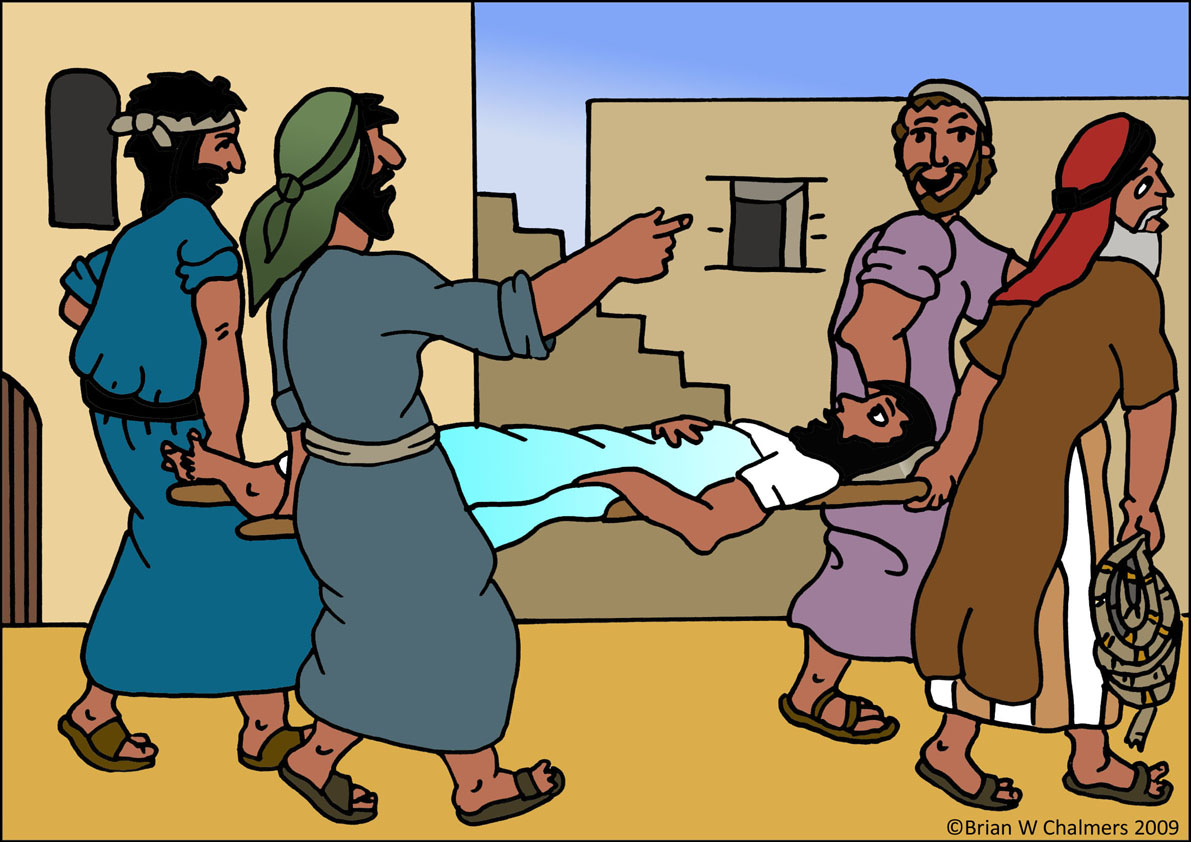
I was reading Mark 2:1-13. For those who don't know their bibles off by heart (shame on you.....you are going stright to hell, do not pass go, do not collect $200...jokes) this bit tells the story of a paralytic man. Jesus is chilling in a house, maybe eating some dinner or something, when the people of the town hear he is there. Like the celebrating swarming of the 1st Century, they all flock to see him, filling the house and the road outside and basically acting like people do around the Kardashians today, but for much better reasons (hopefully). 


In this town there is a paralytic man who is hanging out with his mates, who start to think to themselves that maybe they should get him to see Jesus and maybe something like a healing would happen (because by now stories of Jesus' healings have spread). So they pick up this guy on his mattress and start carrying to the place where Jesus is.

When they get there the doorway is full of people who are not gonna give up their precious opportunity to see and hear Jesus. Perplexed, these fellas start brainstorming and decide to climb up on the roof (which is flat in this part of the world, and usually has stairway access), and dig a hole through the roof (really hope the owner was pissed off that this) and then lowered the man, mattress and all, down to right smack bag in front of the great man himself.


Now I can imagine Jesus looking at the man on the mat, then looking up at the hole in the ceiling and breaking into a huge smile. He is really impressed with the faith and commitment they have all shown. So he looks at the man and says "your sins are forgiven." Some religious elders and stuff and kinda annoyed by this because in their reckoning only God has the authority to forgive sins and Jesus is a man. So Jesus (apparently reading their minds!!!) looks at them and says "which is easier, to forgive sins or to tell this man to get up, pick up his mat and walk. But so you know that the Son of Man [a title Jesus uses for himself] has the authority to forgive sins..." he looks at the paralytic man "stand up, pick up your mat and walk home." And the dude, who is paralysed remember, gets up, picks up his mat and walks out.

Now there are many amazing things about this story. I mean, the paralysed guy would have had muscles that were all shrunken and munted and yet he could get up and walk straight away! The full body healing that occurred here is mind blowing in medical terms. It is not just the cause of his paralysis that is healed, but all of the issues associated with that. All instantaneously!! Flippin wow!


But what struck me yesterday was not the healing. It was that the healing was almost an afterthought in the story. 

Jesus didn't heal the guy immediately. He forgave him first. And then he implies that it is harder to forgive sins than to heal this man.

The healing is not of the first importance to him!!

This made me think about the priorities I would have placed on this story. If I had been Jesus I would have healed the guy first then said something like "BOOM! Look at what I can do! Now believe all you peeps, because I am badass and,as a bonus, I will forgive his sins too!"

In churches I see the same thing. We pray often for people's healing, but how often is there salvation or relationship to God seen as more important than their physical ills. It is the mentality that says "show me a miracle first and then I will believe and ask to be saved."

And yet that is directly opposite to what Jesus does here. His main focus is on the spiritual ill of the man. He sees that the healing that had to occur between this man and God was more deadly, more disastrous than the physical disabilities he had. This reconciliation of man and God was the priority.


How would this attitude impact how we speak to people with disabilities and illnesses? If we adopted this attitude what would change in our hearts towards others? Would we stop seeing people with disabilities as something to be pitied but rather view the state of their faith as more important? Would their disability pale in comparison to their knowledge of God? Would we approach them differently? Would we approach our own issues differently?

I for one am someone who empathizes greatly with people who suffer from disabilities; I have been one and, but for the grace of God, would still be one. I remember feeling like if people prayed for my healing and it didn't happen, that I or they had failed in their faith. I stopped asking for prayer because I felt ashamed.

It was in the prayers of some ladies who prayed for God to be made known to me, not to be healed, that I was healed. They prayed for my salvation, and God, like in this story, forgave me first and healed me second. And the first was more important for me than the second. My shame and fear was lifted. Even if I had remained in my illness I believe that my experience with God in that moment would have changed my life anyway, even if not others perception of my life.

So when you pray for healing for others (and I am not saying not to) remember that of greater importance to God is that this suffering person would know the love and forgiveness of Christ. It is then that true, deep healing is found, that the broken is made whole, and the world is reconciled to its Creator.


Tuesday, September 23, 2014

Christianity in the Workplace

After years of study I have finally completed my Masters degree and am back in the real world working.

Though I loved my study, I really do enjoy the challenge of working each day (though getting up early every morning sucks). I am someone who thrives on a challenge, on deadlines, and on getting paid! I am made for work it seems. I get a kick out of being depended on to get stuff done in time and I am very good at leaving work at work so I can spend time happily at home.

Being back in the work place has raised some interesting issues that I have not had to face in years. Studying theology meant that the majority of the people I saw everyday shared the same beliefs as me, if not the same doctrines, and I was reasonably certain that I could talk about my faith openly and honestly with any of them.

Being in the workplace doesn't offer such opportunities. I am NOT an evangelist. Going up to people and talking to them about Jesus is not one of my giftings. I am able to talk to them about their lives, their issues, their families, but when it comes to faith I get very uncomfortable. I am never sure what to say without offending people. I feel like I am being bigoted if I voice my feelings. I am not sure how to say that I don't agree with someone without coming across as a b***h. 

I think my main issue is that I am a straight talker. I tend to tell it like it is. If I don't agree with you then I will say so. This doesn't lend itself well to situations where people of other faiths may take offense. Though it has its place, straight talk is not always welcome. 

And so I find myself feeling embarrassed and awkward. Not because of my faith but because of my inability to vocalize it well to non-believers. Gimme a room full of Christians wanting to learn more about the Bible and I am away! But fill that same room with non-Christians and I break out in a cold sweat.

This leaves me in an interesting predicament. How do I as a Christian speak well about my faith in the workplace? 


I have already meet a man from the Christadelphian sect/cult. He told me that Jesus is merely a man whom God has honoured above all others, but he is not God. Immediately I was thinking of all the correct theological answers to this statement. But the reality is that this man was raised in this faith and may not appreciate being told he is wrong. Not doubt he is already aware of what other Christians think about Jesus and is use to being told he is wrong. In this situation being silent was much more helpful than being....well....me.

So how does one be a Christian in a workplace filled with different faiths? Does my theological training simply go on the back burner to be used at home and at church only?

To put it simply, no. I did not study theology as a job but as something that impacts my whole life. It is part of my faith and as such impacts my entire life.

Instead of theology being put aside, what I need to do is put my outspokenness aside. 

All Christians, not just me, need to learn when to speak and when to stay silent. We need wisdom to read a situation and know what would best serve the person we are talking to. Love is about catering to them, not about our own need to be proven right.

We also need to remember that it is our lives that speak for us. St. Francis of Assisi once said that Christians need to "preach the kingdom of God constantly, when necessary use words." What he meant was that in our actions, our love for others, our attitude towards our bosses, our ethic toward our work, the way we treat our team mates, it is in those things that our faith is made apparent to others. This isn't always easy. There are days when we don't feel very loving (6:30am everyday for me!) and it may not come through that we are any different from others. But with God's grace, and with the Spirit to strengthen us, we can endure all things.

So what does it mean to speak about my faith at work?

It means to sometimes just stop speaking.

Thursday, October 24, 2013

Why I will be a Christian....Always (part two to 'Why I Can't be a Muslim....Ever')

This post has been a long time coming but I finally made it!! Life has been a bit crazy hectic so apologies to all those who have been holding your breath since part one. You can now all partake in oxygen again.

In part one I explained that I have been studying Islam and, though I have Muslim friends and love them dearly, I find the faith somewhat difficult to accept due to four main points: 1) Muhammad - not the best example of a loving person, 2) the Qur'an - not historically reliable or accurate, 3) the role of women - not seen as equal to men, and 4) the freedom to choose not to believe - it doesn't exist. 

It is only fair then that I now critique my own faith from these four points as well. There is no point me questioning someone else's faith and not looking at mine own through the same lens. So here we go:

1) Jesus - a man I would like to emulate

When looking at the life of Muhammad, according to Islamic scripture, he progresses from a place of relative peace to one where he wages war on his enemies. This is not unusual for the time he lived in and is not shocking that he did so. But Jesus IS shocking!

In a time where it made more sense for a man to proclaim salvation by freeing the known world from out of under the thumb of Rome, Jesus came proclaiming peace. And not only did he say it, he lived it! He never acted in a way that was non-peaceful towards people, he always showed love, and his teachings didn't change as the time went by. In fact, he was so shocking I his message that the crucified him (which is a historical fact that can be verified outside of christian scripture) and he didn't fight back! He showed respect to all people of all walks of life, including his enemies the Romans, and loved all he met. 

If faith was only based on emulating the founders of our faiths, I much prefer Jesus to Muhammad. His message speaks to me about love and respect of all, and his life lives it out. The same cannot be said of Muhammad, even within Islamic scripture.

2) The Bible - historically verifiable

Where the Qur'an raises many questions about historical reliability, the Bible does not have the issues. The New Testament gospel, the books about Jesus' life, can be dated to within one lifetime of his death. They are written with eye witnesses still living. There is also evidence found in sources outside of the scripture by enemies of the church. For example, the Jewish historian Josephus talks about Jesus, which is unusual if it didn't make a splash in the time he was writing. There are also a lot of historical markers within the text that point to exactly when events were occurring. The author Luke often notes the main rulers and events of the time to help guide the readers in understanding when events were happening. These can be verified historically. There is much more to say on this, such as the number of copies of biblical scrolls and writings that have been found and tested against each other for the reliability of the script, but essentially, in terms of historicity, the Bible wins the contest hands down when compared to the Qur'an. Being the nut I am for history, I much prefer knowing the scriptures of my faith can be verified and are believable historically.

3) the Role of Women - loved and respected

Though many people think that women in the bible are often subjugated, this is a misunderstanding. Due to the times it was written in, it would not be unusual to find no women mentioned at all! But this is not the case. All through the Bible women are pivotal in major events, showing God's love to the people, being leaders, shakers and movers. The respect and love that is shown to women by Jesus and his followers is astounding considering the rest of society. Women are not marginalized or seen as second class citizen but are held up as part of the image of God, created to be an equal part of creation and in doing God's work. They are celebrated, audacious, brace, strong, loved, forgiven, and redeemed. The women in the Bible are not at all told to sit down and shut up but are encouraged to seek after God and to lead. As a woman, this encourages me no end in my faith.

4) Freedom to Believe

In Islam there is a strong line of thinking that says 'once a Muslim, always a Muslim' with dire penalties if one tries to change their faith. This is not the same in Christianity. Christianity believes that anyone has the freedom to accept and reject God at anytime. It is the gift of free will that God has given us. God tries to show us in scripture why it is in our very nature to worship something, and that the best something to worship is the one who gives life and love (I.e. God) but we are not robots made to bow to God and worship. We can choose whatever path we want but it is only in God that true freedom, love, and peace can be found. It is only in God that our identity is complete and we can live life to its fullest. But if we choose not to, or we reject what we previously believed, God still loves us the same! It is our choice to follow and it is God's choice to love us unconditionally despite that. Every choice we make has consequences but there is no threat of death or violence from the community of believers if someone leaves because we believe that, as God continues to love, so shall we. I like that.

For all of you who are new to my blog and who don't know me, I didn't always like Christianity. I searched and studied and lived my own way until I made up my mind what faith to follow. I still study, I don't believe that I know everything about the Truth, but nothing I find measures up to the grace of God as found in the Bible. Nothing measure up historically, intelligently, humanly, womanly (?), or anything else. When I realized what it was to follow a God who demanded only that I love God and love others, and who gave me life, love, freedom, and forgiveness in return, I found that I couldn't then deny it. 

All of us are on our own journeys. If you are searching, search well! Don't just believe because of bumper sticker doctrines and key catch phrases. Do your research, have a faith that is as intelligent as it is passionate. And may God guide you on your journey

Wednesday, October 16, 2013

Wanting to Belong

(the second part of "why I can't be a Muslim....ever" will be posted next time but will be taking a break for this post)

This weekend just gone I had the supreme privilege of being asked to go down to New Zealand's most Southern city, Dunedin, to speak about my experience with mental illness and how the church can take part in the healing and reintegration of people with mental illness back into the community. I was there from Friday afternoon til Monday morning and managed to squeeze in six different talks to a variety of groups and churches.

Apart from being absolutely shattered I loved my time down there. It was an awesome city with an awesome vibe and beautiful architecture. Below is the main talk I gave on the Friday night to a bunch of different church people (along with pics of my time in the beautiful city). I hope you enjoy.

----------------------------------------------------------------------------------------------------------------------------------

Mary was upset. A man that she didn't like was whispering nasty things in her ear and touching her inappropriately, and she didn't like it. She told him to stop it but he wouldn't go away. So she started to yell at him, screaming at him to leave her alone. When I found her she was lashing out at the man and screaming at the top of her voice for someone to help her.

Natasha knew that she was sick. She could see it in the mirror every day. Her skin was starting to fall off her bones. She could see where it was tearing and bleeding and she didn't know how to stop it. She had been to the doctor many times about it but they kept telling her that it was ok. She knew it wasn't ok, and by the time I heard her story she was in a panic about how to fix it.

Mary and Natasha are real women who both experienced extremely traumatic events. However, both these women did not receive the help they needed to process what they went through.

For any other people these circumstances would have warranted counselling, church prayer meetings for the women, friends coming alongside to console and advice. Hey would have received medical treatment for their experiences and gained compassion and love from every quarter. Mary and Natasha didn't received any of this.

Because what Mary and Natasha experienced were hallucinations brought on by extreme mental health problems.

Tonight I have the privilege of being able to talk to you about mental health and the church. I can't do that without first telling you a little about myself. I am 28 years old, have been married for two years, am completing my Masters thesis and am looking at doing a PhD in mental health and theology.

6 years ago my life was very different. When I was 12 I developed early onset schizophrenia. By age 19 I lived with full blown psychosis, was in and out of the psychiatric ward at my local hospital, and had attempted to take my life numerous times. At age 22 my parents were taking care of me full time, I had ballooned from 75 kilos to a massive 200+, and I had been told that there was no cure, that mine was a life long sentence.


Enter the little old ladies on the church prayer team. Their prayers that day 6 years ago completely changed my life and thanks to the grace of God I am able to stand before you today free from extreme mental illness, free from medication, and able to share my story and give a voice to those who are often unheard.

My life is a life of terrible suffering and miraculous healing. 

While I was unwell for all those years I was actively involved in my church. This involvement did become less the more unwell I became, but what also became apparent was that I was more UNWELCOME the more unwell I became.

No one ever said to me “You are not welcome here.” I was never asked to leave or told I couldn't join a particular group. I was always greeted warmly at the door every Sunday, and prayed over when I received communion.

I was included. I just didn't belong.

People ceased to ask me out for lunch or dinner. I saw numbers dwindled in my home group and heard the whispers that it was because I made people uncomfortable. I wasn't asked to group outings to the movies or the pools. In fact, between Sunday and Sunday I didn't see anyone from my church. I was alone at home. I was at home, lonely.

As my mental health deteriorated so did my understanding of social niceties. I was a difficult person to be around. I never stopped talking. I would speak too loud. I would fall asleep at church and snore. I would eat anything that stopped long enough for me to grab it and put it in my mouth. I was bad at personal hygiene. I was big, loud, smelly, and an embarrassment to the people around me.

So people stopped being around me. I don't blame them, I really don't. It is really hard to spend time with someone that you can't relax around. It is hard to visit the house of someone who smells bad and won't let you leave. I exhausted people. I drained them.

Natasha exhausted people too. I met Natasha in the ward. She was a sweet woman in her 50's who had experienced a psychotic break with reality. She truly believed her facial skin was tearing off. I avoided her like the plague when I was there. If she could corner you she would tell you non-stop about her face and you would be stuck there for hours. She would follow you around too if you tried to walk away. She was embarrassing and exhausting and so I went out of my way not to talk to her.

I didn't care that Natasha was genuinely concerned about her face. I didn't care that she needed someone to talk to. To me she was a crazy old kook who I wanted to stay away from.

I still think about her and wonder what happened to her.

While in the wards I was exposed to many more people and behaviours that, in my early twenties, I was completely unprepared for. I watched a heavily pregnant woman attack staff and have a fire hose turned on her in an effort to control her. I heard the same lady describe her unborn child as a demon. In reality it was her fathers. I met a 17 year old boy who was dropped off by his parents for suicidal behaviour. He remained there for a week with no visitors. I was verbally abused by a man who thought I was his mother, and I was confronted by nurses who were in equal measure compassionate and careworn. When not in the psych ward I was a daily visitor at the day ward with other mental health patients in the community. Though this was a much more pleasant environment I was surrounded by people I did not know, that were usually much older than me, and by community workers who were understaffed and overworked. The people there embarrassed me with their weird behaviours and I felt left out and alone.

One thing that these people and I had in common was we were all identified by our labels. I was schizophrenic, which meant that nothing I said could be trusted as real. Others were bipolar, which meant you had to watch out for mood swings. Others had extreme depression so they were kept away from anything sharp.

Diagnosis of a mental illness alone creates greater issues for the patient than suffering the illness alone. Diagnosis locates the illness entirely with the individual, apart from their family and environment. It claims that there is something 'wrong' with the person that defines them as outside the acceptable 'norm'. This reduces hope of recovery, creates stigma from labelling, and turns a person into a category.

Currently in NZ today it is estimated that 1 in 4 people will suffer from a mental illness at some point in their lives. It is estimated that 38% of europeans, 62% of Maori, 59% of asians, and 59% of pacific islanders will be diagnosed with a psychotic disorder, such as schizophrenia, in their life time

I find that when I speak of my experiences with mental illness I am met with 1 of four reactions by the listeners. The first is ambivalence. These listeners cannot relate, or don't know how to, and so are quick to change the subject and to move out of the area of a topic of which they have no understanding. They may think that mental illness is “all in your head” and something that can be changed by will power, or they may simply have no interest in the matter.

The second reaction is nervousness and confusion. These listeners mean well but simply do not comprehend what mental illness is or how to respond to it. They may look at you like you are about to pull out a gun and start a rampage, or they may ask to pray for you to release you from the demonic stronghold over your life. These are the listeners that will offer to pray for you but end up lost for words as they become confused as to what to pray for. They often super-spiritualize your experience in order to bring the conversation into a language that they understand.

The third group is perhaps the most interesting of reactions. They are the group that leans forward with eyes shining lapping up every word. When you have finished speaking they will say things like “that is so cool” and ask questions like “so, you could actually see people that weren't there? Was that freaky and what did they look like?” They are curiously excited by what is being said and can ask insensitive questions about experiences in the psych wards. They will also be the ones most likely to call people with mental illness 'crazy' or 'psycho'.

The last group is the minority. They are the listeners who will find you alone later, share their own experiences, cry and pray with you. They usually have had an experience with mental illness and have genuine compassion for what I have been through. But these listeners are few and far between.

Unfortunately mental illnesses have stigmas attached to them that cause reactions of fear, disinterest, and wariness. People buy into the stigma that schizophrenics, and other mental health patients, are WORTHLESS, DIRTY, INSINCERE, DELICATE, SLOW, TENSE, WEAK, FOOLISH, INCOMPETENT, NOT RESPONSIBLE FOR ACTIONS, DANGEROUSLY VIOLENT and UNPREDICTABLE. It is my experience that these stigmas are found just as much within the church as from without, but the added labels of LACK OF FAITH, DEMON POSSESSED, and ANGRY. With these labels it is easy to understand why mental health patients find it hard to contribute in a world where the stigma of your illness is often worse than the illness itself. It is also easy to understand why mental health patients often talk of feeling isolated and rejected by their communities and churches.

The simple fact of the matter is, people do not know how to respond to mental illness.

Despite a quarter of the population having experienced one mental illness of another at some point or another, it seems to be a human issue that we cannot comprehend or relate to suffering that cannot be physically manifested. People will react out of fear and amusement, but very rarely out of genuine compassion.

And this is true of the church as well.

In the last six years I have had to relearn socially cues and behaviours, get use to being on my own with no other voices to keep me company, and to survive on my own outside of my family's care.

I carry with me the memories of people who have not been as fortunate as I. The haunted eyes of the lady that believed the baby in her womb was a demon. The dead eyes of the man that received shock therapy at age 8 and has been institutionalized ever since. The fear in the eyes of the lady who believed the skin on her face was melting off. The sadness in the eyes of the young teenager with suicidal tendencies. I hold in my heart the conversations we all had about being forgotten, rejected, hated by our communities. I remember the questions I received when I told the other patients I was a Christian as to why no one in my church came to visit me. I remember the loneliness.

Which is why when I met Mary I acted in a way that I had never previously acted. 3 years ago I heard screaming coming from over my fence at about 10pm. Concerned, I went over to see what was happening and found Mary, the mother of my next door neighbour, screaming at a man that I could not see, that did not exist. She had arrived to visit her daughter only to find the house empty, her daughter away for the weekend, and it was enough to cause a mental break with reality. In that moment I remembered avoiding Natasha at the wards and so I went and sat with Mary, listened to her worries, answered queries from other concerned neighbours, and called her daughter. I sat with her all night waiting for the mental health response team to arrive with her medication. I refused to let Mary turn into another Natasha in my memory.

Jesus is a friend to the broken.

I believe this with all of my heart. Yet is it so difficult to befriend a person who doesn't speak sense, who may not even notice your existence while you sit with them, who can act in a way that seems barely human sometimes.

Yet Jesus is a friend to the broken.

I knew this couple who had met in the psych ward, fallen in love and, against the wishes of their families, got married. Everyone expected them to spiral out of control mentally and end up back in the state's care. To everyone's surprise, they found a house, moved in, and, when I met them, had been happily married for 10 years. Their love and care for each other meant that they reminded each other to take medication and see the doctor. But the most profound thing that she said to me was “he makes me feel human, he doesn't care about my labels.” They had discovered in each other a person who saw and loved the intrinsic value that the other contained in simply being human. It was through this love and acceptance that they were able to move back into the wider community and form relationships there. Their mental illnesses didn't disappear or even get much better, but in being treated as human rather than as an illness they have been able to find wholeness and healing.

It was in their example that I saw a vision of what the church could be. Loving the broken is more than praying for their healing. It is more than listening to their stories. It is more than asking questions about experiences.

It is about teaching the church as a whole to view people as human rather than as broken. To value the humanness of a person is to see past the brokenness, the medical labels, the sad stories, and to see the heart of a person who longs only to be treated as worthy of attention. It is to act out the continuing mission of Jesus to all who are difficult to relate to and to understand and to reincorporate them back into the community.

In my experience I have seen this love of my humanness a handful of times. I saw it in my next door neighbour who would come over for coffee everyday and sit and listen to me ramble, help me clean my house, tell me off if I did something silly, and give me advise on my struggles. I saw it in a fellow student who discovered that I had difficulty in picking up social cues and developed a system of signals to tell me when I was doing something wrong. I saw it in one of my lecturers who let me breakdown in his office when things were getting on top of me.

These people listened, heard the issue, accepted it and worked with it, rather than trying to change it. For me, they were the church being lived out.

I still don't know how this love for the humanness of people works in churches. There is no 5 step program about reintegrating the mentally ill back into the congregation. But in a country where at least 1 million people will be diagnosed with a mental illness at some point in their lives, there needs to be a beginning of a conversation. And it is a conversation that includes those that it is about. They may be unwell, but they will be very aware of what they feel is missing, what they don't like and how they want to be treated.

It is hard to be friends with people that don't fit, that embarrass us, that are difficult to understand. But our mindset is fundamentally wrong. This was never about US. It isn't about our comfort or discomfort, but about loving people as the created image of God, as people who embodied the Holy Spirit, as people that Jesus came in form of and died for. If we get over our own embarrassment and start viewing all people, well or not, as as worthy of belonging as we are, then maybe, just maybe, people like me won't have to feel lonely anymore.