Search This Blog

Showing posts with label thesis. Show all posts

Thursday, March 27, 2014

Gaming Crisis

As many of you know, I have spent the last year working on a thesis about video gaming and Christian ethics (for related posts see here, here, and here). Apart from this meaning that I haven't blogged consistently for a while, it has also lead me to conclusions that I never thought I would reach. I am, in fact, having a GAMING CRISIS.

When I first started out on my thesis, I was pretty sure I knew where I was gonna end up. I am a pacifist by faith and by nature and the violence that I saw on video games haunted me. Watching my hubby and his friends play Black Ops together really use to bother me, even though what they were 'killing' was a) zombies and b) pixels. My first inclination was to run away and hide.

So when I started talking to hubby and friends about their gaming I was pretty sure that it was wrong. I thought it only glorified violence and killing and that didn't sit well with how I understood my faith and the person of Christ. I also just didn't think it was normal for anyone, no matter what faith, to enjoy watching others get killed, pixelated or not.

I was a student who started on research believing I knew what the conclusion would be. Hopefully I am not the only one who has ever done that.

Colour me shocked when I realised about two months ago that I was changing my mind.

Thanks largely to the work of Kevin Schut and his book Of Games and God (if you are into this kind of stuff seriously spend the few dollars to get this book, it is epic and so well written and easy to understand!) I started to delve into the world of Christianity and gaming and the beauty that there is in this art form. Schut, to my delight, didn't gloss over the difficult questions of violence etc, but rather engaged with it in a way that showed deep commitment to his faith and deep consideration of his love of gaming.
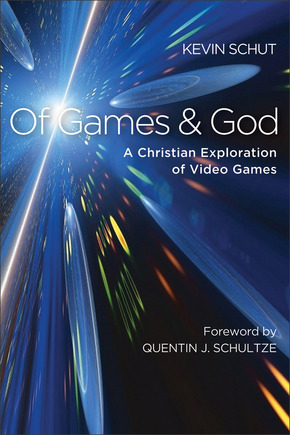
In short, his book blew my mind....and changed my thesis.

I began to seriously consider if I was one of those Christians that I had always despised. You know the ones. They are outside stores that are selling GTA with signs telling people how evil gaming is. I never wanted to be one of those people and yet my attitude was such that I was closed off to the idea that gaming could be anything other than violent and disturbing.

Meet my gaming crisis.

It is rather like a faith crisis, when you suddenly realise that everything you ever thought about the Bible was actually taught to you by a broken human being and maybe they didn't have everything right and maybe, just maybe, you know nothing at all about anything. That was my gaming crisis in a nut shell. I realised that I had formed my biased opinions on a small segment of gaming that I had seen and then blindly applied that to everything without stopping to ask if I actually knew what gaming was.

I was adrift in an ocean of gaming uncertainty.

To some extent I am still there. My thesis is not complete. In fact I am due to start writing my concluding chapters next week. Though I am excited about the discoveries I have made, I am also very uncertain that I really know anything about what I am trying to say anymore. All I know is, my conclusion will not be the same as I thought it would be.

I guess that is the nature of true research.


I have even started to game a little. I have started with Skyrim as my first game because of the possibilities that it offers. I am not tied into a particular character, nor do I have to engage in killing if I don't want to. It is perhaps a baby step, but it is something. This has come about due to the fact that Schut argues that you can't engage with a medium if you aren't involved with it. My friend Kent will be face palming right about now as he has been saying this to me for years, and I simply ignored him, so sorry Kent, I guess I couldn't ignore it when it was in print from a scholar of media haha.

So where does this leave me??

I HAVE NO IDEA!!!

Give me another two months to complete this thesis and I will get back to you. 

Just know, this crisis may end with me playing Black Ops after all.


Wednesday, March 13, 2013

Thesis Update - Halo, Skyrim, Heroes and Saints.


As you may be aware if you are reading this update, I am doing my Masters thesis on biblical ethics and gaming (see link here if you want the low down).


I love getting into reading and trying to take what people have already said and apply it to what I am thinking about. Yes, I am a nerd. I am doing a thesis on gaming!! I think NERD is really an understatement.


Anywho, I have been reading aaaalllloooooooooooot for this thesis already and am really interested by the ideas that are coming out. And as promised, I am going to share my musings with you lucky lucky people.

Got your snacks and beverages? Ok, let's get this thing underway.

A am currently totally in love with the work of one particular ethicists called Samuel Wells. Particularly his book called Improvisation: The Drama of Christian Ethics (which can be found here).

Mind blowing stuff I can tell you.

The overly simplified version of his argument is that "ethics presupposes context, and an understanding of context presupposes narrative; yet if context is to be understood as genuinely communal, and ethics as genuinely interactive, then narrative must be understood as drama." (59)

So what he is saying is that ethics needs to be for people in a time and place, and you only understand that time and place if you understand the story that brought the people to it. You with me? So if that time and place is for a community (not just an individual) and ethics is something we do (not just think about) then the narrative is not just a story that people tell, it is one that is lived out and one that ethics has an impact on.

You following still?

He goes on to argue that for ethics to really really engage with a community (in this circumstance a Christian community that uses the Bible as Scripture) then the Bible is not a text that we memorise and then act out, as a drama would imply. Rather, it is a story we immerse ourselves in to the point where we know it so well we can improvise while remaining faithful to the text, to God, and to our community.

Like I said, this dude blows my mind! Loving it!!!

So even though that in itself is an amazing concept, it is not what I want to look at today.


What I want to engage with is Wells' idea that secular ethics is looking for heroes, while Christian ethics is about making saints.


Bear with me, all will be revealed.....


.....now.


Well's talks about how Aristotle, the Father of ethics, talked about virtues as the way a character of a human should be, rather than ethics being about decisions we make in crisis situations.

Virtues = character.

He held up as the pinnacle of a person who had mastered the virtues the idea of the 'Hero'. The Hero is someone who is strong and brave. They protect the weak and use their strength for good. They rely on their own strength rather than on the weakness of others, and if the fail it is catastrophic for not only themselves but the people they are protecting. The best death would be one in battle, as it takes the most courage to go out and fight so to die this way would be exemplary. 

The Hero = Superman (Christopher Reeves style)

On the other hand you have Aquinas, one of the early church Fathers. He liked the idea of the virtues but he changed them around a bit and said that instead of heroes, the biblical values built Saints. The Saint is someone who is serving of others, filled with the fruits of the Spirit (love peace patience kindness etc), and the virtues help them to follow Christ. 

For the hero the story is about them. For the saint it is about God.

For the hero the story is about celebrating their strengths. For the saint it is about celebrating faith.

The hero will die fighting in inevitable conflict. The saint will die as a martyr because they refused to fight for they believe that Christ has already won.

Hero = Soldier

Saint = Martyr

So this got me to thinking:

What stories are games portraying? Who are they honouring, the saint or the hero? What are they teaching us is the better thing to be?

If you look at any game you can see that it is the Hero that is celebrated. You need to fight well, protect others, be strong and courageous. Death isn't really wanted, but you can rejuvenate and better to die in a battle that to not battle at all.

Gaming loves Heroes.

Because really, what kind of game would it be if the main character was a saint who didn't fight!!?? It wouldn't sell, people don't want to be that character.

And I think that is the thing that most interests me about all this. That deep down we all want to be heroes. We don't want to not pick up a sword/gun/laser and not fight. We don't want to be seen as weak and pathetic. And gaming latches on to that need in all of us to be the hero. We won't accept that maybe only a few people ever will be real heroes, we want to be it too!! We won't accept that in this life there may not be opportunities to be heroic, we want it now!! And we certainly don't want to be told that we SHOULDN'T be a hero, that it is opposite to the biblical message.

So where this has left me is wondering if there is something to being a hero in games that is redeemable. Can we live out of a belief that would have us be martyr's but play games where we get to feed the fantasy of being the opposite?

Can we reconcile the Hero of gaming and the Saint of the Bible??

Tuesday, March 5, 2013

God, Gaming and Thesis Writing

Last night I got the news that my Masters Thesis proposal has been accepted.

What this means is I get to start writing 40,000 words on my chosen topic starting now.

And my topic is (drum role please):

HOW BIBLICAL ETHICS IMPACTS THE WAY WE PLAY MASSIVE MULTI-PLAYER ONLINE GAMES (MMPOGS).

Ooooohhhh yeah, I get to study gaming people!

Unfortunately, due to the size of a thesis it is impossible for me to look at gaming in general, so I had to narrow it to MMPOG's only. But this includes things like World of Warcraft and Second life, both massive virtual worlds with thousands of players.

And you, you lucky people, will get to hear about it as I go along. I would love love love ideas, feedback, thoughts and musings on this as I go. I know there are a lot of gamers out there, tell me what you think about my stuff as I write it up. It may really help shape where I go with it.

The reason I picked this topic was really a bit of a journey for me. See, I am not a gamer!! I don't play video games or partake in online virtual worlds (apart from facebook games, but do they really count). It seems rather odd for me to focus on gaming when I have nothing to do with it. 

But I do through my husband, friends, church, and facebook friends. I know so many gamers. There are those like my hubby who play any game and don't care about whether it is right or not to run down a prostitute in GTA (grand Theft Auto) with your car as it is all only pixels anyway. Or there are others, like a friend of mine, who only ever play the hero first time through a game because they don't like being the 'bad guy'.

This resulted in many conversations. I questioned the use of violence in video games, and asked whether or not someone could justify violence even if it was on a screen. Debates ensued and this thesis topic was born.

See, where I come from is if Jesus is Lord of all, then he is Lord of all worlds, virtual or not. And if he is Lord of the virtual too, then surely the standards and ethics that we follow as Christians apply to the virtual as well as the real. If that is true, then surely we as Christians must critically engage with gaming and establish an understanding of biblical ethical conduct within the virtual world.

The reason that I have decided to go with MMPOG's is because they are where community has been redefined. Actions within MMPOG's affect other players, even if it is their avatars who are being directly involved. It is in these games that a separate reality, not a false reality, has been formed. I say this because for many people, these worlds are where they have their friends, community, social life, and sometimes businesses. The virtual world is their reality.

Because these worlds are reality for players, then there must be a way that a biblical ethical theory can apply to the actions within the worlds.

I hope all that made sense.

The big question that I usually get asked is "does this mean that gaming is bad?" or "are you going to say that Christians shouldn't game?"

Not at all! Just as there are some bad movies out there doesn't mean that Christians are banned from watching movies. What it does mean is that Christians need to be aware of the messages that are being portrayed. It means critically engaging and thinking through the issues that they portray. And, in extreme cases, using wisdom and not watching what is bad for you!!

The same goes for gaming. This is a fairly new industry and yet it has over taken the movie industry in sales and viewers. This means it is prolific in our world and should be taken seriously. As every (!!) NZ home with children under 18 has a gaming capable machine in it, it follows that the church engages with this and thinks about it very seriously.

Because if Christ is the Lord of our lives, then there shouldn't be an area where we can act contrary to what we believe.

The other section of my thesis is about forming a biblical ethic that engages both our actions and our thoughts (ie love God with your heart and mind and strength) and then applying that to gaming. I haven't really got to work on that part yet so that will be the musings of my next post.

See you next time :)