Search This Blog

Showing posts with label belonging. Show all posts

Tuesday, January 20, 2015

Understanding the Misunderstood

For those of you who have been regular readers of my blog, you will be aware that I have spoken around the country regarding mental illness and how those struggling with it are treated. 

For those of you who are new here, go and read my first post. The summation of which is I use to be very mentally unwell. Now I am not.

Well, in all fairness my life has been a little more complicated than that. But the reality is that I once was a patient in psych wards and now I am a well functioning, healthy member of society.

As Sheldon Cooper from Big Bang Theory puts it "I am not crazy, my mother had me tested!"

Because of my history with mental illness I am a little bit worried any time I have a really down day ("Am I getting depressed?") or when I realise that one of my memories might not be 'real'.

That's right, you read that correctly. 

Sometimes my mind likes to play tricks on me. Or at least it use to. When this use to happen it would invent scenarios and people and places in a way that was basically as real to me as reality.

What this means is I have memories of things that never happened but, and this is key, affect me the same way and amount that my 'real' memories do.

Along with this little Matrix-esque mind bender for you, the medication I use to have to take by the bucket load means that my understanding of events in my past can be a little skewed. So events that I thought happened right after the other might be years apart, or happened the other way round. There are also huge chunks of my memory that are just not there. I read through my journals now (which I have kept since I was twelve) and don't recognise events or people that I apparently was hugely impacted by.

What this means for me is that my life history can be a huge tangle of crap covered, arsenic laced, memory string. I find a loose end, give it a tug, and the whole thing can unravel pretty quickly (I regularly thank God that I had the foresight to keep a journal. It has really helped me piece things together).

What this means for people close to me is that this process of discovering the truth of things that happened can be a very painful process. I can remember horrible things done to me that people claim never happened. How can I prove that it did if the other people involved say it didn't happen? Are they telling the truth or covering the ass? 

It also means that those more horrible memories that have had a hugely traumatic impact on my life may not actually be true. And that is a very hard pill to swallow. Some of these memories have shaped my reactions to and relationships with people. Some of these memories have taken me to counsellors and psychologists. Some of them have shaped who I am, for better or worse.

And yet they may have never happened.

Despite what this means for me, for the people I love who are impacted by these memories, it can mean the destruction of our relationship. They (understandably) don't want to trawl through dark memories that they do not view as relevant. Whereas I NEED to trawl through them to determine what is relevant.

Some people refuse to walk this road with me, and I really can't blame them.

What I really want to educate people about, especially those who know and/or care for people with mental illness, is that the things that happen in our minds are as important/impacting to our lives as anything that happens outside of our head; perhaps even more so in some respects. These things can't be refuted or proven, but they shape the way we live, think, love, and fear. And this doesn't stop if the illness goes away.

Take for an example someone who was abused as a kid. This memory will shape them throughout their lives. Perhaps they will overcome and be a survivor who takes control of their lives. Or perhaps they will spiral into the role of the victim and live a life of pain and destruction. Either way, the event shaped them.

Now, imagine that the event of sexual abuse had been hallucinated. Does this make it any less real to the person? If it is a vivid hallucination, there is often no way to tell between the image and reality. They look the same, and feel the same. And they have the same affect on their life.

But mental health patients don't often receive counselling or ongoing support for things that others believe they hallucinated. This means that these significant events in a persons life may never get addressed. They will not receive specialized help for this issue. Basically, a person who has been impacted by child abuse (even though imagined) will remain untreated for this.

I know this is hard to comprehend. It is hard to explain. It is hard to make people understand how real these hallucinations can be, or how devastating medication can be on the memory of a person.

But what needs to be known by people who may (God willing) never experience this mental mind-screw, is that these memories need to be acknowledged and addressed. People with mental health issues need to be talked to, listened to, and really heard. If they are taken seriously as people who have pain that needs to be acknowledged then maybe we will all be one step closer to not ostracizing and ignoring the weakest of our society.

So get out there and start listening people!


Tuesday, October 28, 2014

Which is more important....forgiveness or healing?

On my way to work in the mornings I tend to arrive at the train station about 10mins early so I can sit in my car and read my bible and pray a bit (I know, I am so holy and I put you all to shame). I do this so I start my day the right way, focused on God and not on how tired, grumpy, wanting to be in bed I feel.

Sometimes I just go through the motions. I don't really take in what I am reading and/or I don't really care (maybe not that holy after all). But sometimes what I have read really gets me thinking.

Like yesterday for example.

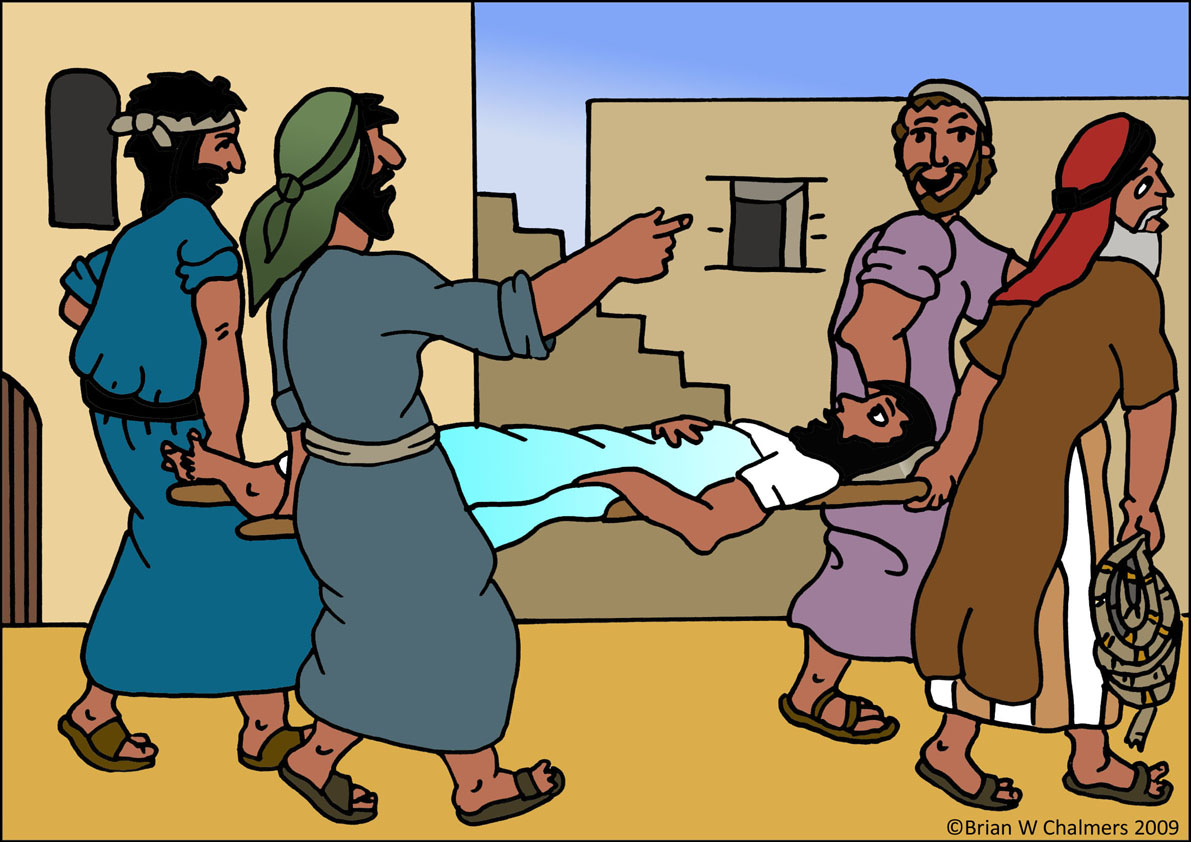
I was reading Mark 2:1-13. For those who don't know their bibles off by heart (shame on you.....you are going stright to hell, do not pass go, do not collect $200...jokes) this bit tells the story of a paralytic man. Jesus is chilling in a house, maybe eating some dinner or something, when the people of the town hear he is there. Like the celebrating swarming of the 1st Century, they all flock to see him, filling the house and the road outside and basically acting like people do around the Kardashians today, but for much better reasons (hopefully). 


In this town there is a paralytic man who is hanging out with his mates, who start to think to themselves that maybe they should get him to see Jesus and maybe something like a healing would happen (because by now stories of Jesus' healings have spread). So they pick up this guy on his mattress and start carrying to the place where Jesus is.

When they get there the doorway is full of people who are not gonna give up their precious opportunity to see and hear Jesus. Perplexed, these fellas start brainstorming and decide to climb up on the roof (which is flat in this part of the world, and usually has stairway access), and dig a hole through the roof (really hope the owner was pissed off that this) and then lowered the man, mattress and all, down to right smack bag in front of the great man himself.


Now I can imagine Jesus looking at the man on the mat, then looking up at the hole in the ceiling and breaking into a huge smile. He is really impressed with the faith and commitment they have all shown. So he looks at the man and says "your sins are forgiven." Some religious elders and stuff and kinda annoyed by this because in their reckoning only God has the authority to forgive sins and Jesus is a man. So Jesus (apparently reading their minds!!!) looks at them and says "which is easier, to forgive sins or to tell this man to get up, pick up his mat and walk. But so you know that the Son of Man [a title Jesus uses for himself] has the authority to forgive sins..." he looks at the paralytic man "stand up, pick up your mat and walk home." And the dude, who is paralysed remember, gets up, picks up his mat and walks out.

Now there are many amazing things about this story. I mean, the paralysed guy would have had muscles that were all shrunken and munted and yet he could get up and walk straight away! The full body healing that occurred here is mind blowing in medical terms. It is not just the cause of his paralysis that is healed, but all of the issues associated with that. All instantaneously!! Flippin wow!


But what struck me yesterday was not the healing. It was that the healing was almost an afterthought in the story. 

Jesus didn't heal the guy immediately. He forgave him first. And then he implies that it is harder to forgive sins than to heal this man.

The healing is not of the first importance to him!!

This made me think about the priorities I would have placed on this story. If I had been Jesus I would have healed the guy first then said something like "BOOM! Look at what I can do! Now believe all you peeps, because I am badass and,as a bonus, I will forgive his sins too!"

In churches I see the same thing. We pray often for people's healing, but how often is there salvation or relationship to God seen as more important than their physical ills. It is the mentality that says "show me a miracle first and then I will believe and ask to be saved."

And yet that is directly opposite to what Jesus does here. His main focus is on the spiritual ill of the man. He sees that the healing that had to occur between this man and God was more deadly, more disastrous than the physical disabilities he had. This reconciliation of man and God was the priority.


How would this attitude impact how we speak to people with disabilities and illnesses? If we adopted this attitude what would change in our hearts towards others? Would we stop seeing people with disabilities as something to be pitied but rather view the state of their faith as more important? Would their disability pale in comparison to their knowledge of God? Would we approach them differently? Would we approach our own issues differently?

I for one am someone who empathizes greatly with people who suffer from disabilities; I have been one and, but for the grace of God, would still be one. I remember feeling like if people prayed for my healing and it didn't happen, that I or they had failed in their faith. I stopped asking for prayer because I felt ashamed.

It was in the prayers of some ladies who prayed for God to be made known to me, not to be healed, that I was healed. They prayed for my salvation, and God, like in this story, forgave me first and healed me second. And the first was more important for me than the second. My shame and fear was lifted. Even if I had remained in my illness I believe that my experience with God in that moment would have changed my life anyway, even if not others perception of my life.

So when you pray for healing for others (and I am not saying not to) remember that of greater importance to God is that this suffering person would know the love and forgiveness of Christ. It is then that true, deep healing is found, that the broken is made whole, and the world is reconciled to its Creator.


Wednesday, April 30, 2014

A Mother to Hold


Mother's day is coming up fast in New Zealand. It is a time of families celebrating the woman who brought them into the world. Churches around the country will be holding special services that have children handing out gifts to mothers and a sermon focusing on someone like Mary, the mother of Christ.

There is a lot of stuff around mothers happening around me at the moment. My new niece was born a few days ago. Many of my friends are pregnant and giving birth. My mother in law is battling cancer so my thoughts are with her a lot. Hubby and I are thinking about babies and when to start trying for them.

Mothers have such an impact on our lives, for good or bad.

And recently I have been missing my mum.

I have talked briefly about my breakdown in relationship with my parents without giving too many details. I don't think this is the place to vent my issues with them. But suffice to say that it is coming up three years since I have seen or had any contact with either my mother or father.

I love my parents deeply, we just have some issues that we can seem to sort out.

Every month or something hits me that makes me miss my mother like crazy.

This month it is mothers day.

It makes my heart hurt when I think about her. I feel empty and lost, like a part of me is missing. I wish that things could be different and we could talk about things but life is not like that. Things happen.

The thing I have been thinking about is around all of this.

Mother's day was created by a card company that wanted to make profit. The church in NZ has bought into it hook line and sinker. And though I admire the sentiment I think it is wrong.

It is wrong to have one day alone when we celebrate mothers. I think it is wrong because it puts pressure on all those people who don't have mothers, can't be mothers, or have issues with their mothers. It affectively isolates those who are already hurting by pushing in their face what they don't have.

Don't get me wrong, I am not trying to push my misery on everyone but being a grinch about mothers day. I am all for celebrating mothers. But I don't think that the church, a place that is (or should be) full of broken and hurting people, should be focusing on this topic when the rest of society already does.

I mean let's face it, if my church doesn't do mothers day, I am not exactly going to miss it am I. It is all over TV, shop windows, and magazines. I would have to live in a cave to miss the sales that are being pushed in my face to buy my mother things like diamond rings and dishwashers. 

Kids will still be able to get cards for their mums, make them breakfast in bed, and show love to the special woman in their life.

But church? Church should be at least one place where people can find solace for their pain. That on a day that might be really hard for people there is a place where they can go and not have it shoved in their face. Where grief is acknowledged as much as joy.


But the church doesn't do grief well. We don't know how to lament with others. Church songs tend to focus on how happy we are that Jesus has saved us, rather than the pain of still living in a fallen world. We emphasise one and totally ignore the other.

In the last 24 hours I have talked to three women who find mothers day hard. One cannot have children, one doesn't have children yet but really wants them, and one whose mother has passed. Each of these women go to church and each them told me how they would avoid church on mother's day. 

There is something wrong when the people who are hurting are avoiding church in order to avoid more pain.

It's time to rethink how we do this in such a way that we don't diminish the joy but don't ignore the pain either.

Wednesday, October 16, 2013

Wanting to Belong

(the second part of "why I can't be a Muslim....ever" will be posted next time but will be taking a break for this post)

This weekend just gone I had the supreme privilege of being asked to go down to New Zealand's most Southern city, Dunedin, to speak about my experience with mental illness and how the church can take part in the healing and reintegration of people with mental illness back into the community. I was there from Friday afternoon til Monday morning and managed to squeeze in six different talks to a variety of groups and churches.

Apart from being absolutely shattered I loved my time down there. It was an awesome city with an awesome vibe and beautiful architecture. Below is the main talk I gave on the Friday night to a bunch of different church people (along with pics of my time in the beautiful city). I hope you enjoy.

----------------------------------------------------------------------------------------------------------------------------------

Mary was upset. A man that she didn't like was whispering nasty things in her ear and touching her inappropriately, and she didn't like it. She told him to stop it but he wouldn't go away. So she started to yell at him, screaming at him to leave her alone. When I found her she was lashing out at the man and screaming at the top of her voice for someone to help her.

Natasha knew that she was sick. She could see it in the mirror every day. Her skin was starting to fall off her bones. She could see where it was tearing and bleeding and she didn't know how to stop it. She had been to the doctor many times about it but they kept telling her that it was ok. She knew it wasn't ok, and by the time I heard her story she was in a panic about how to fix it.

Mary and Natasha are real women who both experienced extremely traumatic events. However, both these women did not receive the help they needed to process what they went through.

For any other people these circumstances would have warranted counselling, church prayer meetings for the women, friends coming alongside to console and advice. Hey would have received medical treatment for their experiences and gained compassion and love from every quarter. Mary and Natasha didn't received any of this.

Because what Mary and Natasha experienced were hallucinations brought on by extreme mental health problems.

Tonight I have the privilege of being able to talk to you about mental health and the church. I can't do that without first telling you a little about myself. I am 28 years old, have been married for two years, am completing my Masters thesis and am looking at doing a PhD in mental health and theology.

6 years ago my life was very different. When I was 12 I developed early onset schizophrenia. By age 19 I lived with full blown psychosis, was in and out of the psychiatric ward at my local hospital, and had attempted to take my life numerous times. At age 22 my parents were taking care of me full time, I had ballooned from 75 kilos to a massive 200+, and I had been told that there was no cure, that mine was a life long sentence.


Enter the little old ladies on the church prayer team. Their prayers that day 6 years ago completely changed my life and thanks to the grace of God I am able to stand before you today free from extreme mental illness, free from medication, and able to share my story and give a voice to those who are often unheard.

My life is a life of terrible suffering and miraculous healing. 

While I was unwell for all those years I was actively involved in my church. This involvement did become less the more unwell I became, but what also became apparent was that I was more UNWELCOME the more unwell I became.

No one ever said to me “You are not welcome here.” I was never asked to leave or told I couldn't join a particular group. I was always greeted warmly at the door every Sunday, and prayed over when I received communion.

I was included. I just didn't belong.

People ceased to ask me out for lunch or dinner. I saw numbers dwindled in my home group and heard the whispers that it was because I made people uncomfortable. I wasn't asked to group outings to the movies or the pools. In fact, between Sunday and Sunday I didn't see anyone from my church. I was alone at home. I was at home, lonely.

As my mental health deteriorated so did my understanding of social niceties. I was a difficult person to be around. I never stopped talking. I would speak too loud. I would fall asleep at church and snore. I would eat anything that stopped long enough for me to grab it and put it in my mouth. I was bad at personal hygiene. I was big, loud, smelly, and an embarrassment to the people around me.

So people stopped being around me. I don't blame them, I really don't. It is really hard to spend time with someone that you can't relax around. It is hard to visit the house of someone who smells bad and won't let you leave. I exhausted people. I drained them.

Natasha exhausted people too. I met Natasha in the ward. She was a sweet woman in her 50's who had experienced a psychotic break with reality. She truly believed her facial skin was tearing off. I avoided her like the plague when I was there. If she could corner you she would tell you non-stop about her face and you would be stuck there for hours. She would follow you around too if you tried to walk away. She was embarrassing and exhausting and so I went out of my way not to talk to her.

I didn't care that Natasha was genuinely concerned about her face. I didn't care that she needed someone to talk to. To me she was a crazy old kook who I wanted to stay away from.

I still think about her and wonder what happened to her.

While in the wards I was exposed to many more people and behaviours that, in my early twenties, I was completely unprepared for. I watched a heavily pregnant woman attack staff and have a fire hose turned on her in an effort to control her. I heard the same lady describe her unborn child as a demon. In reality it was her fathers. I met a 17 year old boy who was dropped off by his parents for suicidal behaviour. He remained there for a week with no visitors. I was verbally abused by a man who thought I was his mother, and I was confronted by nurses who were in equal measure compassionate and careworn. When not in the psych ward I was a daily visitor at the day ward with other mental health patients in the community. Though this was a much more pleasant environment I was surrounded by people I did not know, that were usually much older than me, and by community workers who were understaffed and overworked. The people there embarrassed me with their weird behaviours and I felt left out and alone.

One thing that these people and I had in common was we were all identified by our labels. I was schizophrenic, which meant that nothing I said could be trusted as real. Others were bipolar, which meant you had to watch out for mood swings. Others had extreme depression so they were kept away from anything sharp.

Diagnosis of a mental illness alone creates greater issues for the patient than suffering the illness alone. Diagnosis locates the illness entirely with the individual, apart from their family and environment. It claims that there is something 'wrong' with the person that defines them as outside the acceptable 'norm'. This reduces hope of recovery, creates stigma from labelling, and turns a person into a category.

Currently in NZ today it is estimated that 1 in 4 people will suffer from a mental illness at some point in their lives. It is estimated that 38% of europeans, 62% of Maori, 59% of asians, and 59% of pacific islanders will be diagnosed with a psychotic disorder, such as schizophrenia, in their life time

I find that when I speak of my experiences with mental illness I am met with 1 of four reactions by the listeners. The first is ambivalence. These listeners cannot relate, or don't know how to, and so are quick to change the subject and to move out of the area of a topic of which they have no understanding. They may think that mental illness is “all in your head” and something that can be changed by will power, or they may simply have no interest in the matter.

The second reaction is nervousness and confusion. These listeners mean well but simply do not comprehend what mental illness is or how to respond to it. They may look at you like you are about to pull out a gun and start a rampage, or they may ask to pray for you to release you from the demonic stronghold over your life. These are the listeners that will offer to pray for you but end up lost for words as they become confused as to what to pray for. They often super-spiritualize your experience in order to bring the conversation into a language that they understand.

The third group is perhaps the most interesting of reactions. They are the group that leans forward with eyes shining lapping up every word. When you have finished speaking they will say things like “that is so cool” and ask questions like “so, you could actually see people that weren't there? Was that freaky and what did they look like?” They are curiously excited by what is being said and can ask insensitive questions about experiences in the psych wards. They will also be the ones most likely to call people with mental illness 'crazy' or 'psycho'.

The last group is the minority. They are the listeners who will find you alone later, share their own experiences, cry and pray with you. They usually have had an experience with mental illness and have genuine compassion for what I have been through. But these listeners are few and far between.

Unfortunately mental illnesses have stigmas attached to them that cause reactions of fear, disinterest, and wariness. People buy into the stigma that schizophrenics, and other mental health patients, are WORTHLESS, DIRTY, INSINCERE, DELICATE, SLOW, TENSE, WEAK, FOOLISH, INCOMPETENT, NOT RESPONSIBLE FOR ACTIONS, DANGEROUSLY VIOLENT and UNPREDICTABLE. It is my experience that these stigmas are found just as much within the church as from without, but the added labels of LACK OF FAITH, DEMON POSSESSED, and ANGRY. With these labels it is easy to understand why mental health patients find it hard to contribute in a world where the stigma of your illness is often worse than the illness itself. It is also easy to understand why mental health patients often talk of feeling isolated and rejected by their communities and churches.

The simple fact of the matter is, people do not know how to respond to mental illness.

Despite a quarter of the population having experienced one mental illness of another at some point or another, it seems to be a human issue that we cannot comprehend or relate to suffering that cannot be physically manifested. People will react out of fear and amusement, but very rarely out of genuine compassion.

And this is true of the church as well.

In the last six years I have had to relearn socially cues and behaviours, get use to being on my own with no other voices to keep me company, and to survive on my own outside of my family's care.

I carry with me the memories of people who have not been as fortunate as I. The haunted eyes of the lady that believed the baby in her womb was a demon. The dead eyes of the man that received shock therapy at age 8 and has been institutionalized ever since. The fear in the eyes of the lady who believed the skin on her face was melting off. The sadness in the eyes of the young teenager with suicidal tendencies. I hold in my heart the conversations we all had about being forgotten, rejected, hated by our communities. I remember the questions I received when I told the other patients I was a Christian as to why no one in my church came to visit me. I remember the loneliness.

Which is why when I met Mary I acted in a way that I had never previously acted. 3 years ago I heard screaming coming from over my fence at about 10pm. Concerned, I went over to see what was happening and found Mary, the mother of my next door neighbour, screaming at a man that I could not see, that did not exist. She had arrived to visit her daughter only to find the house empty, her daughter away for the weekend, and it was enough to cause a mental break with reality. In that moment I remembered avoiding Natasha at the wards and so I went and sat with Mary, listened to her worries, answered queries from other concerned neighbours, and called her daughter. I sat with her all night waiting for the mental health response team to arrive with her medication. I refused to let Mary turn into another Natasha in my memory.

Jesus is a friend to the broken.

I believe this with all of my heart. Yet is it so difficult to befriend a person who doesn't speak sense, who may not even notice your existence while you sit with them, who can act in a way that seems barely human sometimes.

Yet Jesus is a friend to the broken.

I knew this couple who had met in the psych ward, fallen in love and, against the wishes of their families, got married. Everyone expected them to spiral out of control mentally and end up back in the state's care. To everyone's surprise, they found a house, moved in, and, when I met them, had been happily married for 10 years. Their love and care for each other meant that they reminded each other to take medication and see the doctor. But the most profound thing that she said to me was “he makes me feel human, he doesn't care about my labels.” They had discovered in each other a person who saw and loved the intrinsic value that the other contained in simply being human. It was through this love and acceptance that they were able to move back into the wider community and form relationships there. Their mental illnesses didn't disappear or even get much better, but in being treated as human rather than as an illness they have been able to find wholeness and healing.

It was in their example that I saw a vision of what the church could be. Loving the broken is more than praying for their healing. It is more than listening to their stories. It is more than asking questions about experiences.

It is about teaching the church as a whole to view people as human rather than as broken. To value the humanness of a person is to see past the brokenness, the medical labels, the sad stories, and to see the heart of a person who longs only to be treated as worthy of attention. It is to act out the continuing mission of Jesus to all who are difficult to relate to and to understand and to reincorporate them back into the community.

In my experience I have seen this love of my humanness a handful of times. I saw it in my next door neighbour who would come over for coffee everyday and sit and listen to me ramble, help me clean my house, tell me off if I did something silly, and give me advise on my struggles. I saw it in a fellow student who discovered that I had difficulty in picking up social cues and developed a system of signals to tell me when I was doing something wrong. I saw it in one of my lecturers who let me breakdown in his office when things were getting on top of me.

These people listened, heard the issue, accepted it and worked with it, rather than trying to change it. For me, they were the church being lived out.

I still don't know how this love for the humanness of people works in churches. There is no 5 step program about reintegrating the mentally ill back into the congregation. But in a country where at least 1 million people will be diagnosed with a mental illness at some point in their lives, there needs to be a beginning of a conversation. And it is a conversation that includes those that it is about. They may be unwell, but they will be very aware of what they feel is missing, what they don't like and how they want to be treated.

It is hard to be friends with people that don't fit, that embarrass us, that are difficult to understand. But our mindset is fundamentally wrong. This was never about US. It isn't about our comfort or discomfort, but about loving people as the created image of God, as people who embodied the Holy Spirit, as people that Jesus came in form of and died for. If we get over our own embarrassment and start viewing all people, well or not, as as worthy of belonging as we are, then maybe, just maybe, people like me won't have to feel lonely anymore.

Monday, July 22, 2013

Family, Brokenness, and Acceptance

Wow, I just checked out my blog stats and I am nearly on 8000 views of this blog! A MASSIVE thank you to you, yes YOU, who is reading this and who keeps me writing. I am honoured by your presence here and the fact that you find me interesting enough to keep reading.

If you are new here I recommend reading my blog post 'My Story' in order to understand where I am coming from on various issues. I make a lot more sense with a little background knowledge going on. 

I have been pretty slack at these blog posts recently as I am currently writing my Masters thesis and that tends to take up a lot of my time. As well as that I run a small group for young adults (hence the various blogs with flowcharts) so the planning for that can (or should) take up some of my time too. But enough excuses, let's get on with the show.

I have up until today refrained from talking at length about my relationship with my family. This has been for several reasons.

1) I have felt that it is unfair to share my issues without them having a proper chance to respond.
2) Talking to a bunch of strangers (no offence guys) is perhaps not the best way to deal with some issues.

Yesterday however, I watched a Dr. Phil show that really hit a nerve. It was portraying a family of three children who were desperate to make contact with their dad but he kept making excuses. Though they all proclaimed love for their father they were furious at him and he couldn't understand why they kept yelling at him if they wanted a relationship.

That's not what struck me.

There was a young girl, 17yo, who said that if she could have anything it would be to be able to call her dad, talk about her problems, do fun things with him, and have him as her confidant. 

It was a heartfelt plea.

It was also a major cause of the problem.

I say this because I truly believe that the world has told us what a 'perfect' family should look like. I am not talking about a mum, a dad, and 2.5 kids. What I am talking about is the 'Simpsons' idea. 

Family is dysfunctional, the Simpsons tells us, but ultimately everyone will get along. By the end of the half hour dad will have realised his mistake and apologised, mum would've realised she loves the silly man after all, the kids will realise they are being little terrors and stop, and everyone will live happily ever after...well at least until the next episode. 

This is pretty much how every family works on TV sitcoms. It is what I grew up on, what most of my generation grew up on, and it has, I believe, warped our understanding of the nature of humanity.

See, people can suck. I mean really suck. The number of solo parent families out there would suggest that mum and dad, or partner, or whatever, don't always figure it out. The number of abused kids would suggest that parents don't always like their children. The number of runaways would suggest that kids don't always like their parents.

Because we are broken. Though we all yearn for the love of our family, we live a world where people are broken, where we are broken, and it isn't so easy to reconcile our differences. 

I love my family. Not a day goes by when I don't think about my parents. But I haven't seen or talked to them for two years. We have issues. My brokenness has affected them and their brokenness has affected me. My parents weren't perfect, but neither were they awful and neglectful. We just found that some of our difficulties were too big for us to be able to work through in a way that we both agreed on.

It breaks my heart that things ended up this way between us. I can't tell you how much I would love to pick up the phone and have a nice, happy conversation with my dad.

But that isn't our reality.

Our reality is that things are broken. There are no credits that will role after a family hug. There is no canned laughter that will play when we all realise that we misunderstood each other. There is no being able to run into each others arms in slow motion when we see each other again.

There is love, but it is a love tainted by our issues.

And that is what hit me about the young girls story on Dr. Phil. She had in her head this idea of what she believed was the perfect father-daughter relationship. But it was clear from the program that the father had no intention, or ability, to be this father. She wanted a fantasy instead of accepting the reality, no matter how painful that might be.

My mother-in-law once told me that relationships only work when we lower our expectations of people. We need to stop imagining what we want in someone and accept the reality of what our relationship with them really is. Sometimes it means walking away and letting the relationship go. Sometimes it means having to work damn hard at ourselves and at a relationship, but this is only possible if both parties are willing to try and work at it. And sometimes, in those wonderful moments, it means accepting what is and living in the love that is offered and accepted.

But let me get one thing straight: acceptance and forgiveness are NOT the same as reconciliation. We can accept the reality of a broken relationship. We can even learn to forgive the hurts and the pain that are caused within that relationship. But that does not mean that reconciliation will, or can, happen.

I have forgiven my parents for any hurt, real or imagined, that they caused me. I know this because I am not angry at them any more. For years I was. I was bitter and twisted about every little thing that I remembered them doing (or not doing). It ate me up inside. I would rant and rage against them for hours at a time. We would have screaming matches and things were said that I regret. Things were heard that I have now let go of. I learnt to forgive them and love them as human beings who did their very best to love me as they knew how. I pray for the all the time and hold them very dear in my heart.

But we do not have a relationship. The reasons for that I am choosing not to go into in this forum but I will say that it is because we have been unable to agree upon a 'safe zone' for us to work out our issues. Sometimes relationships need outside help, sometimes it is not emotionally (or even physically) safe to step back into the same situation without boundaries and safety being established first. Sometimes reconciliation doesn't happen. And that is ok.

Forgiveness does also not demand forgetting. The old adage 'forgive and forget' has done so much harm to people in relationships that are toxic. We CANNOT forget. It is impossible to forget. So what we are told to do is sweep our issues under the carpet and pretend they never happened. This leads to cycles of destruction in relationships. Ever wonder why an abused woman goes back to her abuser? Because she chose to ignore past behavior instead of letting it help her determine what will happen in the future. Sometimes the only way to find healing is to leave the environment that perpetuates old behaviors. And sometimes forgiveness cannot happen until we choose to NOT forget what has happened before and instead face it, address it, and, if need be, walk away from it until it changes.

It is ok to learn to forgive and not be reconciled. In a perfect world we could do that, but this isn't a perfect world and we are far from perfect people. We do what we can, we try as hard as possible, and then we have to learn to accept what is. And sometimes what exists is a relationship broken beyond repair. Or one that needs more time to heal.

You can forgive and learn to love without relationship being reestablished.

If you have a difficult relationship with your family members, you are not alone! There are so many of us out there who are longing for the love of parent/sibling/spouse/child. There are so many of us who weep for what we dreamed could have been and for the reality of what is.

We understand. You are not alone. 

My prayers are with all families. They are with every broken person who prays for a miracle and yet despairs that it will never come. They are with every person who misses someone they love because of the brokenness of their relationship.

May God give you peace and may you know God as your parent who loves you and comforts you. May you know Joy.


Wednesday, July 3, 2013

The Silence Surrounding Psych Wards

Just today I presented a paper at the conference for Theology, Disability and the People of God. I shared my story of my experience with mental illness and used that as a framework for working with people with mental illness. I have shared my paper below. Feel free to share this and pass on to educate others in this area. Blessings

-------------------------------------------------------------------------------------------------------------------------------


Today I am here to talk to you about the impact of mental illness and the importance of the church community in the healing and restoration of people who suffer from these illnesses.


10 years ago I was diagnosed with early onset schizophrenia, an illness that usually besets someone in their 30's that I started experiencing at age 12. The diagnosis was given when I was 19, just after I had got married, and by then it had been seven years of mental health issues with little help or understanding. For all my teenage years I had struggled with extreme depression, self harming, eating disorders, and audible and visual hallucinations. In some ways it was a relief to finally be told what was wrong with me, and in others it felt like a death sentence. I had been labelled as incurable. For 5 years after my diagnosis I was placed on medication after medication, I was kept in psych wards for varying stretches of time, my every action was viewed through the symptoms of my illness. I was told the damage in my brain was irreversible, would get worse as I aged and I would be a permanent mental health patient. There was no hope for me, my family or my new marriage.

While in the wards I was exposed to people and behaviours that, in my early twenties, I was completely unprepared for. I watched a heavily pregnant woman attack staff and have a fire hose turned on her in an effort to control her. I heard the same lady describe her unborn child as a demon. In reality it was her fathers. I listened to a woman for hours tell me how the skin on her face was falling off. I met a 17 year old boy who was dropped off by his parents for suicidal behaviour. He remained there for a week with no visitors. I was verbally abused by a man who thought I was his mother, and I was confronted by nurses who were in equal measure compassionate and careworn. When not in the psych ward I was a daily visitor at the day ward with other mental health patients in the community. Though this was a much more pleasant environment I was surrounded by people I did not know, that were usually much older than me, and by community workers who were understaffed and overworked.

Eventually my illness took its toll on my loved ones and my marriage fell apart 3 years after it had started. My mother had to quit her job to become my full time carer. She had to wake me up, make me shower, take me for walks, and made all my food so I ate well. We were all told that this would be a life long sentence. There was no hope for recovery. Despite my mothers care, my mental health continued to deteriorate and I lived only for my chance to die. My family described me at that time as a zombie with no purpose or care for my life.

It is with this experience that I speak to you today.

I find that when I speak of my experiences with mental illness I am met with 1 of four reactions by the listeners.

The first is ambivalence. These listeners cannot relate, or don't know how to, and so are quick to change the subject and to move out of the area of a topic of which they have no understanding. They may think that mental illness is “all in your head” and something that can be changed by will power, or they may simply have no interest in the matter.

The second reaction is nervousness and confusion. These listeners mean well but simply do not comprehend what mental illness is or how to respond to it. They may look at you like you are about to pull out a gun and start a rampage, or they may ask to pray for you to release you from the demonic stronghold over your life. These are the listeners that will offer to pray for you but end up lost for words as they become confused as to what to pray for. They often super-spiritualize your experience in order to bring the conversation into a language that they understand.

The third group is perhaps the most interesting of reactions. They are the group that leans forward with eyes shining lapping up every word. When you have finished speaking they will say things like “that is so cool” and ask questions like “so, you could actually see people that weren't there? Was that freaky and what did they look like?” They are curiously excited by what is being said and can ask insensitive questions about experiences in the psych wards. They will also be the ones most likely to call people with mental illness 'crazy' or 'psycho'. They also tend to be under the age of 30.

The fourth group is the minority. They are the listeners who will find you alone later, share their own experiences, cry and pray with you. They usually have had an experience with mental illness and have genuine compassion for what you have been through. But these listeners are few and far between.

Unfortunately mental illnesses have stigmas attached to them that cause reactions of fear, disinterest, and wariness. People buy into the stigma that schizophrenics, and other mental health patients, are WORTHLESS, DIRTY, INSINCERE, DELICATE, SLOW, TENSE, WEAK, FOOLISH, INCOMPETENT, NOT RESPONSIBLE FOR ACTIONS, DANGEROUSLY VIOLENT and UNPREDICTABLE. It is my experience that these stigmas are found just as much within the church as from without, but with the added labels of LACK OF FAITH, DEMON POSSESSED, and ANGRY. With these labels it is easy to understand why mental health patients find it hard to contribute in a world where the stigma of your illness is often worse than the illness itself. It is also easy to understand why mental health patients often talk of feeling isolated and rejected by their communities and churches.

The simple fact of the matter is, people do not know how to respond to mental illness.
Mental illness are two words that create a lot of confusion as they encompass a plethora of issues from emotional depression through to full blown psychosis that requires institutionalization. There are also very few mental illnesses that are truly understood, even by the medical profession, and this leads to misunderstanding, fear and isolation within families and communities.

Diagnosis of a mental illness creates greater issues for the patient than suffering the illness alone. Diagnosis locates the illness entirely with the individual, apart from their family and environment. It claims that there is something 'wrong' with the person that defines them as outside the acceptable 'norm'. This reduces hope of recovery, creates stigma from labelling, and turns a person into a category.

Currently in NZ today it is estimated that 1 in 4 people will suffer from a mental illness at some point in their lives. It is estimated that 38% of europeans, 62% of Maori, 59% of asians, and 59% of pacific islanders will be diagnosed with a psychotic disorder, such as schizophrenia, in their life time.[1]

Despite a quarter of the population having experienced one mental illness or another at some point in their lives, it seems to be a human issue that we cannot comprehend or relate to, a suffering that cannot be physically manifested. People will react out of fear and amusement, but very rarely out of genuine compassion.

And this is true of the church as well.

I was healed 6 years ago. Some ladies from the prayer group at church answered my mothers cry for help and started a chain of events that means I am able to stand before you today and speak for those that often have no voice. In the last six years I have had to relearn social cues and behaviours, get use to being on my own with no other voices to keep me company, try to reclaim what of my memories are true events and what were hallucinations, and to survive on my own outside of my family's care.

I carry with me the memories of people who have not been as fortunate as I. The haunted eyes of the lady that believed the baby in her womb was a demon. The dead eyes of the man that received shock therapy at age 8 and has been institutionalized ever since. The fear in the eyes of the lady who believed the skin on her face was melting off. The sadness in the eyes of the young teenager with suicidal tendencies. I remember the sadness, fear, anger and finally hate in the eyes of my ex-husband who received no support and who lost all hope.

I hold in my heart the conversations I had with the other patients about being forgotten, rejected, hated by our communities. I remember the questions I received when I told the other patients I was a Christian as to why no one in my church came to visit me in the ward. I remember the loneliness each one of us had wrapped around us like a blanket.

Jesus is a friend to the broken.

I believe this with all of my heart. Yet is it so difficult to befriend a person who doesn't speak sense, who may not even notice your existence while you sit with them, who can act in a way that seems barely human sometimes.
 
Yet Jesus is a friend to these broken.


Often these people who hear and see things very differently from us don’t suffer beause of their own psychosis. They suffer at the hands of people who tell them that they are abnormal, strange, ill, and crazy. They suffer from the side affects of medication and from the isolation and loniless. They suffer from feelings of guilt as they are told how much of a burden they are. They suffer because of us.

I knew this couple who had met in the psych ward, fallen in love and, against the wishes of their families, got married. Everyone expected them to spiral out of control mentally and end up back in the state's care. To everyone's surprise, they found a house, moved in, and, when I met them, had been happily married for 10 years. Their love and care for each other meant that they reminded each other to take medication and see the doctor. But the most profound thing that she said to me was “he makes me feel human, he doesn't care about my labels.” They had discovered in each other a person who saw and loved the intrinsic value that the other contained in simply being human. It was through this love and acceptance that they were able to move back into the wider community and form relationships there. Their mental illnesses didn't disappear or even get much better, but in being treated as human rather than as an illness they have been able to find wholeness and healing.

It was in their example that I saw a vision of what the church could be. Loving the broken is more than praying for their healing. It is more than listening to their stories. It is more than asking questions about experiences.


It is teaching the church as a whole to view people as human rather than as broken. To value the humanness of a person is to see past the brokenness, the medical labels, the sad stories, the stange behaviour, and to see the heart of a person who longs only to be treated as worthy of attention. It is to act out the continuing mission of Jesus to all who are difficult to relate to and to understand and to reincorporate them back into the community.

In my experience I have seen this love of my humanness a handful of times. I saw it in my next door neighbour who would come over for coffee everyday and sit and listen to me ramble, help me clean my house, tell me off if I did something silly, and give me advise on my struggles. I saw it in a fellow student who discovered that I had difficulty in picking up social cues and developed a system of signals to tell me when I was doing something wrong. I saw it in one of my lecturers who let me breakdown in his office when things were getting on top of me. I saw it in my new parents in law who accepted my history and embraced me for it.

These people listened, heard the issue, accepted it and worked with it, rather than trying to change it. For me, they are the church being lived out.


I still don't know how this love for the humanness of people works in churches. There is no 5 step program about reintegrating the mentally ill back into the congregation. But in a country where at least 1 million people will be diagnosed with a mental illness at some point in their lives, there needs to be a beginning of a conversation. And it is a conversation that includes those that it is about. They may be unwell, but they will be very aware of what they feel is missing, what they don't like and how they want to be treated. We need to start asking ourselves and our congregations some deep searching questions and listening to the answers from those who live with these illnesses.


I would love to say that I now run a ministry within psych wards. To be honest, I have found the very idea odf stepping back into that environment so terrifying that I have not been able to face it yet. It has been 6 years but the scars on my heart are still healing. Yet I do what I can to show that people with mental illness are worth time and effort. One evening I sat with a nextdoor neighbours mother when she turned up at their house while they were out. I found her yelling at the fence after not taking her medication for three days.

I sat with her all night as she told me about the things that only she could see. In that seemingly meaningless rambling I heard her fear of being alone, her joy of being able to talk to others and share what she was seeing. I saw her love for me as she told me I was smarter than Einstein and had the faith and feet of aborigines in the desert. I heard her concern as she asked me about my imagined Maori husband Steve and why he was angry at me. She talked about things that weren’t physically true, but in it she cared, she loved. And I loved her by listening.

I don’t know if my actions made an impact on her or if she even realised who I was or if I really existed, but to this day I am in contact with her daughter and the daughter’s partner and have been able to introduce them to a Christianity that loves even their broken mother.

I would love to stand here before you and say I am totally free of all impairment. I am not. I still suffer from chronic anxiety issues, depressive episodes, and intense migraines. I have had to take time out of my study to deal with these issues and I thank God for my husband Luke who is as steady as a rock and reminds me to breathe slowly. He is my reminder of God's redemption and resurrection power in my life/

Our congregations should have these people in them. The fact that often they don’t reflects on the fact that we have not questioned the way we practice church. Questions like:

What would it look like to have mental health patients not just tolerated in our worship meetings, but celebrated and embraced?

What does it mean to learn from the broken, rather than to teach them?

What would it look like to seek friendship with the friendless, not for their health sake but because they are human and have something to offer?

What would it look like, as Swinton talked about on Monday, to stop having to act as the host or hostess and instead receive hospitality from people with mental health issues?

What does it mean to act towards the least of these as we would Jesus?

What would it look like to treat them like we would our Saviour?


[1] Wheeler, A.  NZ Medical Journal 2005